USAID DEC
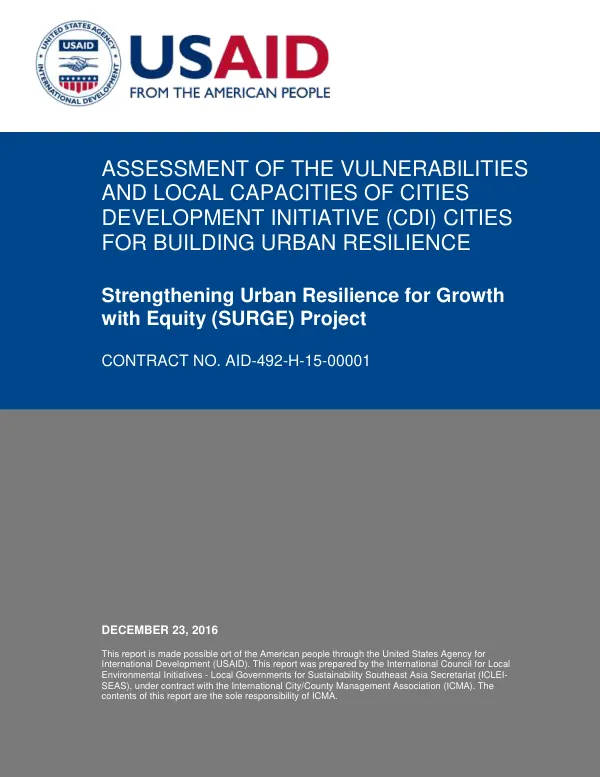
Assessment of the Vulnerabilities and Local Capacities of Cities Development Initiative (CDI) Cities for Building Urban Resilience
Sign inINTERNATIONAL CITY AND COUNTY MANAGEMENT ASSOCIATION
Assessment of the Vulnerabilities and Local Capacities of Cities Development Initiative (CDI) Cities for Building Urban Resilience
The Cities Development Initiative (CDI) Cities Development Initiative is a program aimed at strengthening urban resilience for growth with equity.
2016 · 79 pages
Sign in to readA free account is required to download.
Abstract
The initiative is part of the USAID Strengthening Urban Resilience for Growth with Equity (SURGE) Project, which was launched in 2015. The project focuses on six cities in the Philippines, including Batangas City, Puerto Princesa City, Iloilo City, Tagbilaran City, Cagayan de Oro City, and Zamboanga City. The assessment of vulnerabilities and local capacities of these cities was conducted to identify areas of concern and opportunities for improvement. The assessment involved a comprehensive review of existing data and information, as well as field observations and stakeholder consultations. The results of the assessment are presented in this report, which provides an overview of the vulnerabilities and capacities of each city. Batangas City is one of the cities assessed in this report. The city is located in the CALABARZON region and has a population of approximately 329,000 people. The city is prone to flooding and landslides, which are exacerbated by its location in a flood-prone area. The assessment identified several vulnerabilities in the city, including its flood-prone areas, landslides, and storm surges. The city's water distribution system is also vulnerable to flooding, which can affect the supply of clean water to residents. Puerto Princesa City is another city assessed in this report. The city is located in the Palawan province and has a population of approximately 220,000 people. The city is prone to flooding and landslides, which are exacerbated by its location in a flood-prone area. The assessment identified several vulnerabilities in the city, including its flood-prone areas, landslides, and storm surges. The city's water distribution system is also vulnerable to flooding, which can affect the supply of clean water to residents. Iloilo City is a city located in the Western Visayas region and has a population of approximately 457,000 people. The city is prone to flooding and landslides, which are exacerbated by its location in a flood-prone area. The assessment identified several vulnerabilities in the city, including its flood-prone areas, landslides, and storm surges. The city's water distribution system is also vulnerable to flooding, which can affect the supply of clean water to residents. Cagayan de Oro City is a city located in the Northern Mindanao region and has a population of approximately 675,000 people. The city is prone to flooding and landslides, which are exacerbated by its location in a flood-prone area. The assessment identified several vulnerabilities in the city, including its flood-prone areas, landslides, and storm surges. The city's water distribution system is also vulnerable to flooding, which can affect the supply of clean water to residents. Zamboanga City is a city located in the Zamboanga Peninsula region and has a population of approximately 861,000 people. The city is prone to flooding and landslides, which are exacerbated by its location in a flood-prone area. The assessment identified several vulnerabilities in the city, including its flood-prone areas, landslides, and storm surges. The city's water distribution system is also vulnerable to flooding, which can affect the supply of clean water to residents. Overall, the assessment identified several vulnerabilities in each of the six cities assessed, including flood-prone areas, landslides, and storm surges. The cities' water distribution systems are also vulnerable to flooding, which can affect the supply of clean water to residents. The assessment also identified opportunities for improvement, including the development of flood-resilient infrastructure, the implementation of early warning systems, and the enhancement of community resilience. The assessment recommends that each city develop a comprehensive disaster risk reduction and management plan, which should include measures to mitigate the effects of flooding, landslides, and storm surges. The plan should also include strategies to enhance community resilience, including the development of early warning systems and the provision of emergency response services. The assessment also recommends that each city conduct a comprehensive review of its water distribution system to identify areas of vulnerability and opportunities for improvement. The review should include an assessment of the system's capacity to supply clean water to residents during flooding events. In addition, the assessment recommends that each city develop a low-emission development strategy, which should include measures to reduce greenhouse gas emissions and promote sustainable development. The strategy should also include strategies to enhance community resilience, including the development of early warning systems and the provision of emergency response services. Overall, the assessment provides a comprehensive overview of the vulnerabilities and capacities of each city, and identifies opportunities for improvement. The recommendations outlined in the assessment can help each city develop a comprehensive disaster risk reduction and management plan, which can enhance community resilience and promote sustainable development.
Related documents