USAID DEC
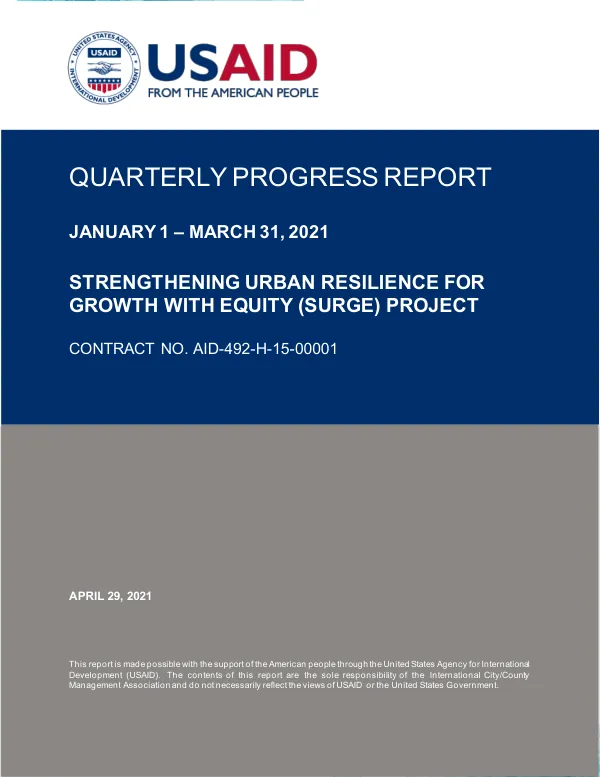
USAID Strengthening Urban Resilience for Growth with Equity (SURGE) Project 2nd Quarter Progress Report, January to March 2021
Sign inINTERNATIONAL CITY AND COUNTY MANAGEMENT ASSOCIATION
USAID Strengthening Urban Resilience for Growth with Equity (SURGE) Project 2nd Quarter Progress Report, January to March 2021
The Cities Development Initiative (CDI) is a key component of the USAID SURGE Project, which aims to strengthen urban resilience for growth with equity in eight partner cities in the Philippines.
2021 · 131 pages
Sign in to readA free account is required to download.
Abstract
The CDI cities are Batangas, Cagayan de Oro, General Santos, Iloilo, Legazpi, Puerto Princesa, Tagbilaran, and Zamboanga. The initiative focuses on improving local capacity in inclusive and resilient development, with a particular emphasis on disaster risk reduction and climate change adaptation (DRR-CCA). In the second quarter of Year 6 of the Project, the CDI cities made significant progress in implementing DRR-CCA policies. Batangas City, Iloilo City, and Puerto Princesa City included DRR-CCA mitigation strategies in the formulation and upgrade of Comprehensive Land Use Plans (CLUP) and other provincial development planning processes. This is a critical step towards mainstreaming DRR-CCA policy in the cities. The SURGE Project also facilitated the launch of a short course on urban development and local planning (UDLP) at the University of the Philippines-Visayas College of Management (UPV-CM) in Iloilo City. The course was developed in partnership with Golden Gate University (GGU) in San Francisco, California. Additionally, GGU signed a partnership agreement with Mindanao State University-General Santos Campus (MSU-GSC) in General Santos City for university collaboration and knowledge-sharing. The SURGE Project initiated talks with two universities in Puerto Princesa and Zamboanga for similar initiatives. In terms of sanitation, the SURGE Project, in cooperation with Coca-Cola Foundation Philippines, Inc., facilitated the building and turnover of 31 handwashing facilities in public areas in Cagayan de Oro and Tagbilaran. The SURGE Project also assisted Cagayan de Oro, General Santos, Tagbilaran, and Puerto Princesa with updating and formulating their ten-year Local Sustainable Sanitation Plans (LSSP). The LSSPs will enable the cities to leverage funding from the national government and other sources, such as the Department of Public Works and Highways' National Septage and Sewerage Management Program (DPWH-NSSMP). Furthermore, the SURGE Project helped train 98 representatives of CDI city water utilities, water districts (WDs), and rural waterworks and sanitation associations (RWSAs) in the review, monitoring, and audit of Water Safety Plans. The training will enable the water utilities and RWSAs to comply with the Philippine National Drinking Water Standards and to support, strengthen, and monitor the safety mechanisms in place. The COVID-19 response assistance across CDI cities and Marawi City was also a key focus area for the SURGE Project in the second quarter of Year 6. The Project provided support to the cities in terms of capacity building, technical assistance, and resource mobilization to help them respond to the pandemic. In Marawi City, the SURGE Project focused on recovery work on water and sanitation rehabilitation activities. The Project helped facilitate the building and turnover of 31 handwashing facilities in public areas, as well as the updating and formulation of the city's ten-year Local Sustainable Sanitation Plan (LSSP). The LSSP will enable Marawi City to leverage funding from the national government and other sources to support its recovery efforts. Overall, the SURGE Project made significant progress in the second quarter of Year 6, with a focus on improving local capacity in inclusive and resilient development, disaster risk reduction and climate change adaptation, sanitation, and COVID-19 response assistance. The Project's efforts will continue to support the CDI cities and Marawi City in their efforts to build resilience and achieve sustainable development.
Related documents