USAID. BUR. FOR POLICY AND PROGRAM COORDINATION. CENTER FOR DEVELOPMENT INFORMATION AND EVALUATION (CDIE)
Assessment of USAID"s fertilizer market privatization program : Bangladesh
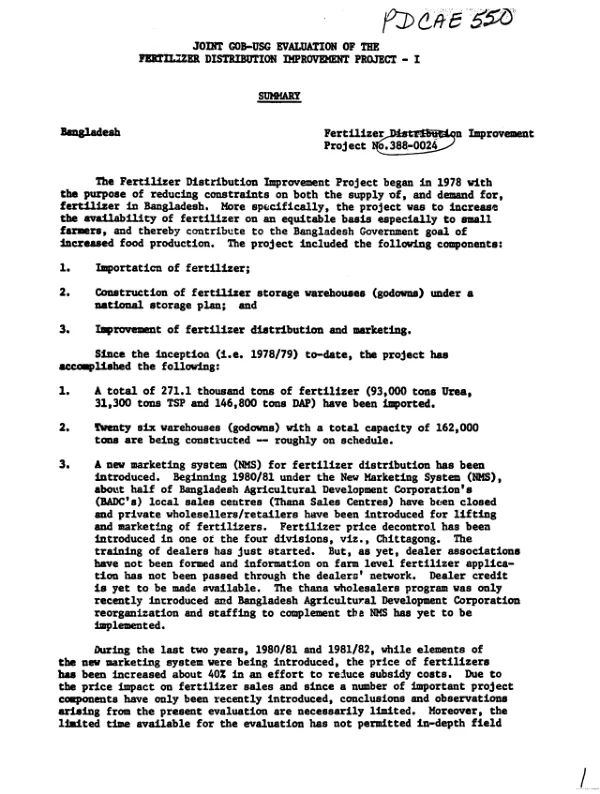
Evaluates USAID"s fertilizer distribution improvement (FDI) program, comprised of FDI-I (1978-85) and its follow-on FDI-II (1984-94), in Bangladesh.
Poulin, Roger · 1994
Sign in to readA free account is required to download.
Abstract
USAID"s FDI program in Bangladesh is considered by some to be its most significant privatization effort: (1) the fertilizer market has been fully privatized and liberalized, including price decontrol, the removal of government subsidies, and the disengagement of the Bangladesh Agricultural Development Corporation; (2) the private sector response to the changed environment has been strong, competitive, and effective -- fertilizer supplies have more than doubled, and all government costs associated with the distribution of fertilizer have been completely eliminated; and (3) fertilizer use has increased, resulting in increased agricultural production, increased rural incomes, and food self-sufficiency. In addition, the national economy is significantly and measurably stronger, and the large majority of Bangladeshi, urban as well as rural, are significantly better off. FDI"s success can be attributed to the following four key factors, two of which were within the control of the program and two of which were not. (1) The vision underlying the program was simple, consistent, and strongly felt. (2) The program was well conceived and has been implemented effectively. (3) The overall policy framework has been supportive of the program"s privatization objectives. (4) The liberalization and privatization of fertilizer distribution have had a major and far-reaching economic impact. This has been due to the existence of an economically viable, technical package that made fertilizer use profitable and greatly increased agricultural production, particularly rice. The following lessons were learned. (1) It is important to build support within the government and affected institutions before bringing about policy changes that significantly affect the private and parastatal sectors and imply basic changes in government social, and economic agendas. As changes occurred in the project, impacts were monitored and discussed with all interested parties. These consultations provided the basis for further changes that eventually led to the full privatization of fertilizer distribution. (2) Changing government policies affecting agribusiness require highly qualified technical assistance which can effectively deal with the government and private sector. The key to the program"s success has been the availability of highly competent fertilizer marketing experts. (3) The project provides strong evidence that the private sector responds efficiently and effectively to undistorted open markets. At every step of the fertilizer privatization process, private businesses have expeditiously replaced the Bangladesh Agricultural Development Corporation (BADC). This has resulted in cuts in distribution costs and more timely delivery to farmers. (4) The program also reconfirms the difficulty of bringing about institutional change in the public sector, even in the context of highly successful policy change. The greatest resistance to privatization of Bangladesh"s fertilizer distribution system has come from the implementing agency, the BADC. (5) Finally, privatization efforts are greatly facilitated when they are implemented in the context of overall economic liberalization. The difficulty of overcoming BADC and political resistance to privatization indicates that the effort probably would have failed had there not been high-level government and widespread donor support for economic liberalization.