USAID. MISSION TO BANGLADESH
Joint GOB - USG evaluation of the fertilizer distribution improvement project - I
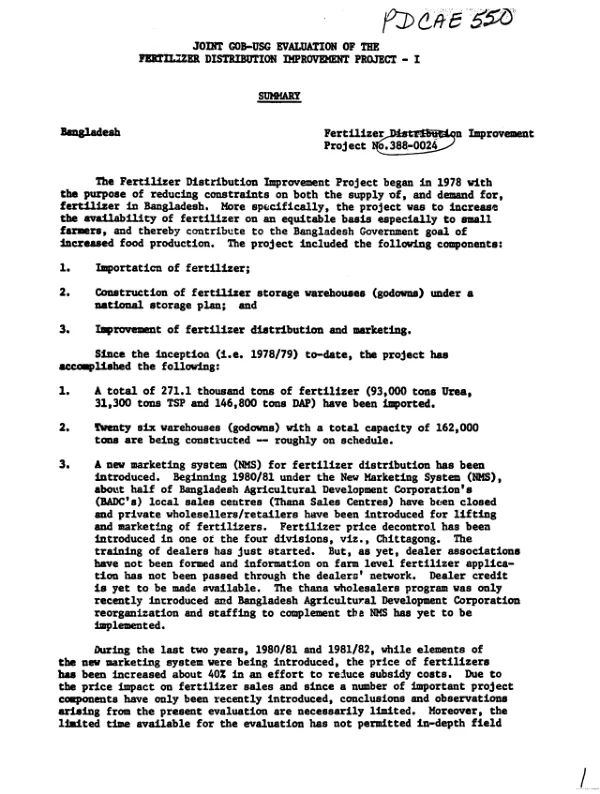
Evaluates project to increase the availability of fertilizer in Bangladesh.
1982
Sign in to readA free account is required to download.
Abstract
Special evaluation covers the period 1978-82; no methodology is noted. Under the project, 271,100 tons of fertilizer have been imported and 26 warehouses, with a combined capacity of 162,000 tons, are being constructed, roughly on schedule. In addition, the New Marketing System (NMS) for fertilizer distribution through private firms has been introduced, leading to the closure of about half of the Bangladesh Agricultural Development Corporation's (BADC) local sales centers. Fertilizer price decontrol was introduced in one of four divisions (Chittagong). Under the NMS, dealer training has begun, but dealer associations have not yet been formed, the dealers' network has not distributed information on fertilizer application to small farmers, dealer credit is not yet available, and wholesale distribution has only just begun. The BADC has not yet implemented planned staffing and organizational changes to complement the NMS. Since 1980, fertilizer prices have increased about 40% due to an effort to reduce subsidy costs. This price increase, along with the fact that a number of important project components have only recently been introduced, makes definitive judgment on project success impossible at this time. Yet, the project has demonstrated both the success of Bangladesh's public sector in fertilizer production and distribution and the potential of the private sector in fertilizer retailing. Key recommendations are to gradually increase private sector involvement in fertilizer distribution and to monitor the effects of the NMS carefully, making better use of available data while continuing to collect new data. Finally, a 1979-80 study indicated that small farmers used more fertilizer per acre and obtained higher outputs per unit of fertilizer than did large farmers.
Related documents