INTERNATIONAL SCIENCE AND TECHNOLOGY INSTITUTE, INC. (ISTI)
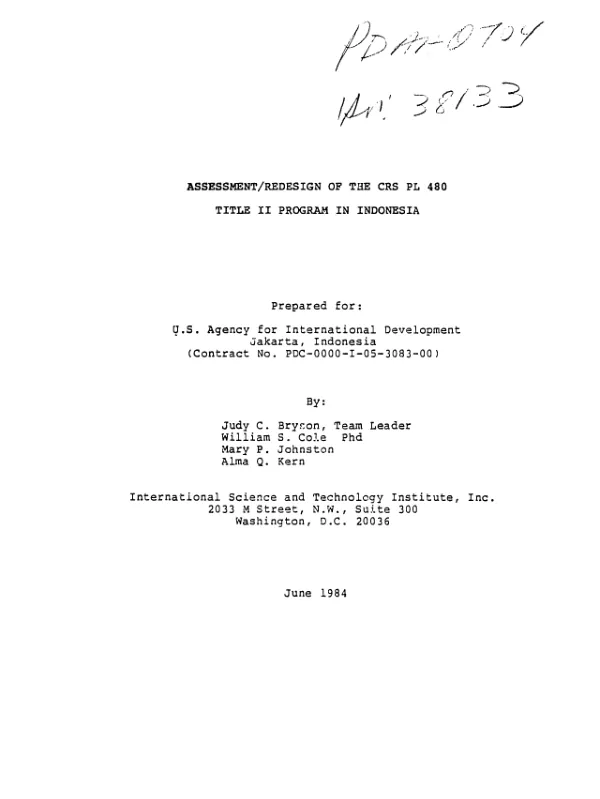
Assessment/redesign of the CRS PL-480 Title II program in Indonesia
Evaluates program content and management of Catholic Relief Services' (CRS) Food for Work (FFW) and Food and Nutrition (FNP) programs in Indonesia.
Bryson, Judy C.|Cole, William S. · 1984
Sign in to readA free account is required to download.
Abstract
Special evaluation covers the period to 10/83 and is based on document review and interviews with staff of USAID/T, CRS and its counterpart agencies, and with beneficiaries. CRS and its counterparts lack a national framework for FFW/FNP activities and effective project selection and monitoring systems. Counterpart staffs, although well-trained and motivated, are preoccupied with accountability and logistics at the expense of the more qualitative aspects of planning and management. CRS's Indonesian headquarters is understaffed, and funding for staff salaries and other management expenses is highly unstable. FFW projects consist mainly of cooperative community labor projects, generally not targeted on the underemployed/unemployed; the remuneration level is very low. Impacts cannot be determined definitively, due to lack of an adequate data system (a serious problem), but case studies (attached for both FFW and FNP projects) suggest that impacts are favorable; workmanship at the projects is impressive. Some projects require considerable technical expertise, which is not always readily available. The FNP previously lacked clearly defined goals, but in 4/83 CRS and its counterparts articulated a program (being implemented in 23 pilot centers) which includes recipient commitment, targeting, food distribution, growth surveillance, cadre training and support, nutrition education, income generation, and a plan to graduate children of good nutritional status. Data inadequacy again precludes impact evaluation; the new program is promising, but will take years to implement in full. It is recommended that a 5-year plan be developed during FY84. Specific proposals include: creating a national program framework, with uniform management and data systems; correcting the overemphasis on food accountability by focusing on nutrition improvement and simplifying the food accounting system; and maintaining the overall budget through FY89 and recipient levels through FY87. FFW should target the poor (as both participants and beneficiaries), deemphasizing infrastructure. FNP purposes should be clarified to give CRS and counterpart staffs a firm concept of expected achievements.