USAID DEC
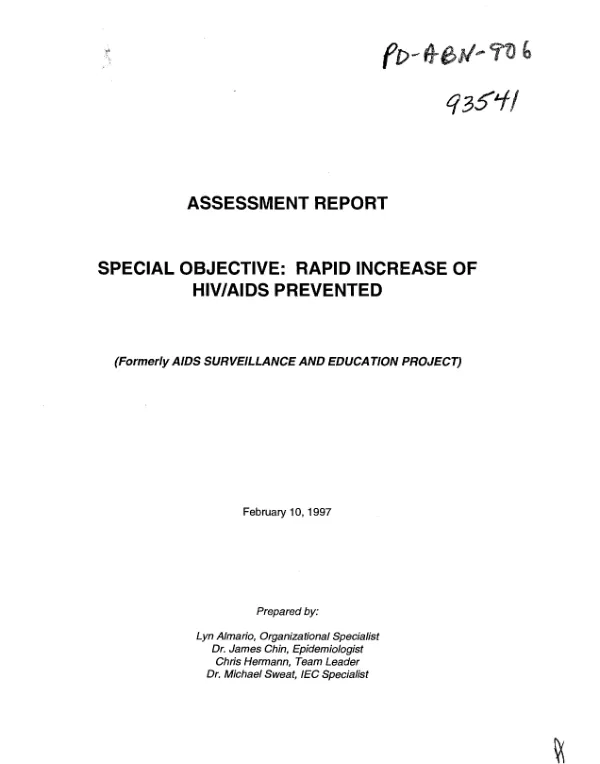
Assessment report -- special objective : rapid increase of HIV/AIDS prevented (formerly AIDS surveillance and education project)
Sign inUSAID. MISSION TO PHILIPPINES
Assessment report -- special objective : rapid increase of HIV/AIDS prevented (formerly AIDS surveillance and education project)
Evaluates project to reduce the prevalence of sexually transmitted diseases (STDs) and HIV/AIDS in the Philippines through programs in surveillance and education (ASEP project).
Hermann, Chris; Almario, Lyn · 1997
Sign in to readA free account is required to download.
Abstract
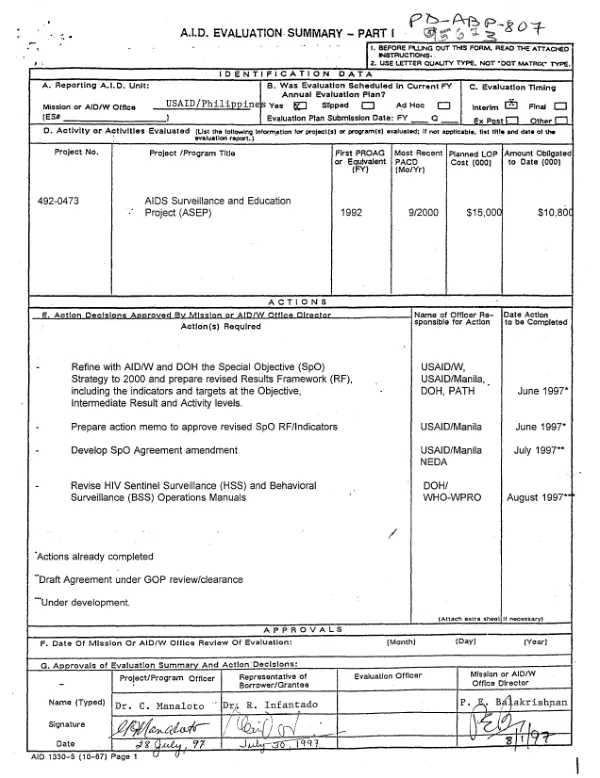
Evaluation covers the period 1993-2/97 against a 9/97 PACD. ASEP is the principal activity under the Mission"s Special Objective for HIV/AIDS. Although HIV Sentinel Surveillance (HSS) has clarified current STD/HIV prevalence, several problems need to be addressed. Current survey methods do not provide adequate coverage of individuals from high-risk groups for testing, and include too many risk groups per round. In addition, HSS has expanded to too many sites, and there is no uniform behavioral surveillance questionnaire for use by the Department of Health (DOH) for HSS or by NGOs for their behavioral monitoring surveys. The World Health Organization (WHO) has provided effective support for the HSS, but has been hard pressed to continue its services since the end of the Global Program for AIDS (GPA) grant in 12/95. In the education component, Program of Appropriate Technology in Health (PATH) and the implementing NGOs have generally done an excellent job in developing new institutional capacities to inform high-risk individuals about STD/HIV/AIDS prevention. Mass media information, education, and communication (IEC) have been of high quality, and PATH has consistently fielded high caliber professional staff who have worked effectively with counterparts, particularly at the local government and NGO levels. On the down side, the NGOs do not routinely address the psychological, social, and environmental correlates of risk, and their primary IEC strategy of using peers to deliver health education messages is probably inappropriate for young girls, who are increasingly being used as commercial sex workers. Further, while the training of health care workers in syndromic management of STDs has been positive, the widespread lack of STD drugs hinders successful STD control, and resistance to antibiotics is a serious and growing problem. Finally, a number of systemic barriers thwart risk reduction among ASEP target groups, including poor access to STD treatment, discouragement of condom use by commercial sex establishment managers and the related lack of public monitoring in this matter, the failure of the legal system to suppress child health work, and inadequate financial support for STD/HIV prevention. As a result, ASEP"s primary target groups remain at high risk, though HIV prevalence in the general population remains low. At the organizational level, the Philippines National AIDS Council (PNAC), though still weak, recently produced a national AIDS strategic plan, and the DOH is reportedly planning to institutionalize its STD/HIV/AIDS unit. Also, new linkages are being developed between the DOH and the local government units (LGUs), and working models of LGU-NGO collaboration in STD/AIDS prevention and control have been produced in three cities. However, coordination between ASEP"s education and surveillance components remains weak. ASEP needs a working steering committee that will bring together the surveillance and education components as well as the STD/HIV/AIDS program management. In addition, it is unclear how current surveillance and education activities will be sustained after USAID assistance ceases. National and/or local governments are unlikely to allocate adequate funding for these activities from their existing budgets. Identifying new revenue sources to fund these activities is necessary. Based on the recommendations of this assessment, the Mission should consider revising its indicators at the Special Objective, Intermediate Results (IR), and Activity levels. The IR currently focuses solely on behavioral changes to measure progress. USAID needs to consider expanding the IR to include knowledge and attitudinal changes as intermediate or precursor steps to achieving widespread behavioral change. The overall recommendation is to extend ASEP activities for 3 years until 9/2000 and to increase funding for LGU and NGO education programs, identification of local financing mechanisms for STD/HIV-related activities, and policy analysis and advocacy.