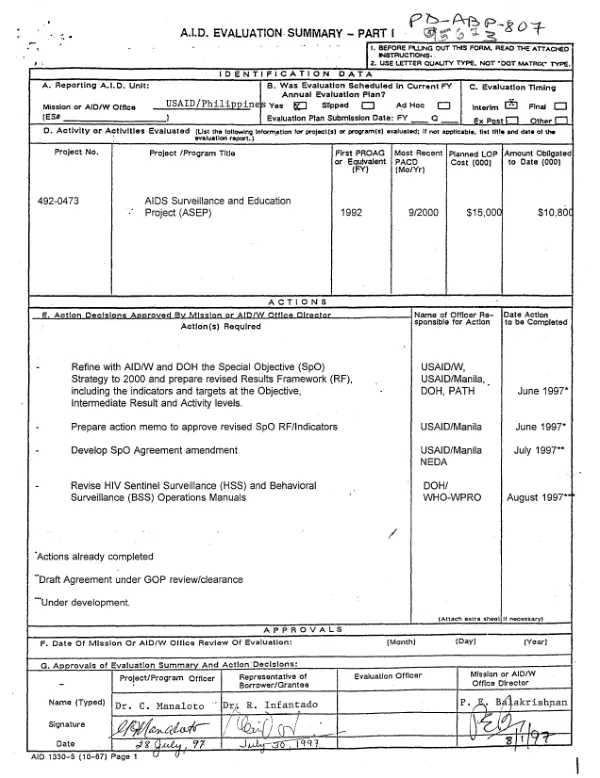
USAID. MISSION TO PHILIPPINES
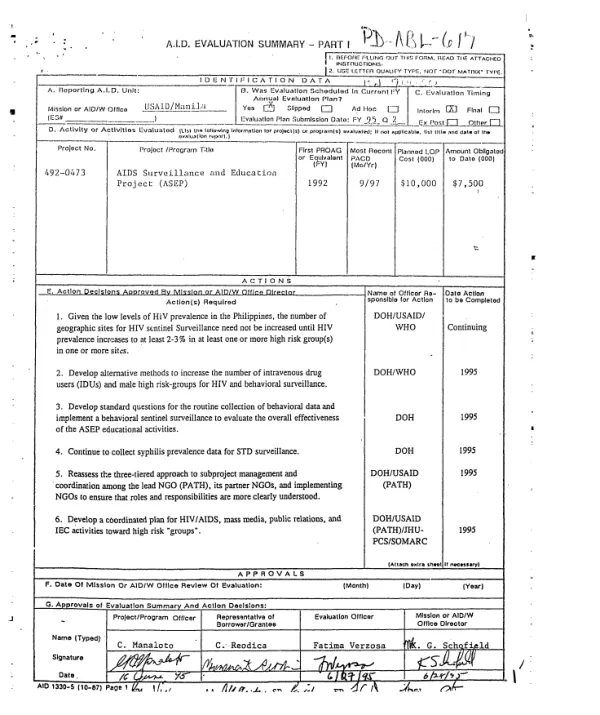
AIDS surveillance and education project (ASEP)
Summarizes evaluation (PD-ABN-906) of the AIDS Surveillance and Education project (ASEP), designed to (1) establish an HIV sentinel surveillance system (HSS) with sites placed strategically throughout the Philippines to detect HIV infection among high-risk groups, and (2) support mass media and community-based education, communication, and public relations programs aimed at preventing the spread of HIV/AIDS.
1997
Sign in to readA free account is required to download.
Abstract
Interim evaluation covers the period 1993-2/97. The HSS is implemented by the Department of Health-Field Epidemiology Training Program through a grant to the World Health Organization. Education programs are implemented through a Cooperating Agency Agreement with the Program for Appropriate Technology (PATH) and engage governmental agencies at the national and local levels through selected NGOs. Both programs target high-risk groups, namely, registered female commercial sex workers and freelance female commercial sex workers, male sex workers, injecting drug users, men who have sex with men, and patients at STD clinics. In 9/96, the project was incorporated into a Special Objective (SpO) with the stated goal of "Rapid Spread of HIV/AIDS Prevented" and its PACD extended 3 years to 9/2000 at increased funding. The evaluation finds that there has been no "explosion" of HIV infections thus far in the Philippines, with average HIV prevalence rate at
Connected topics
Related documents
Documents in this collection
 1997
1997USAID DEC
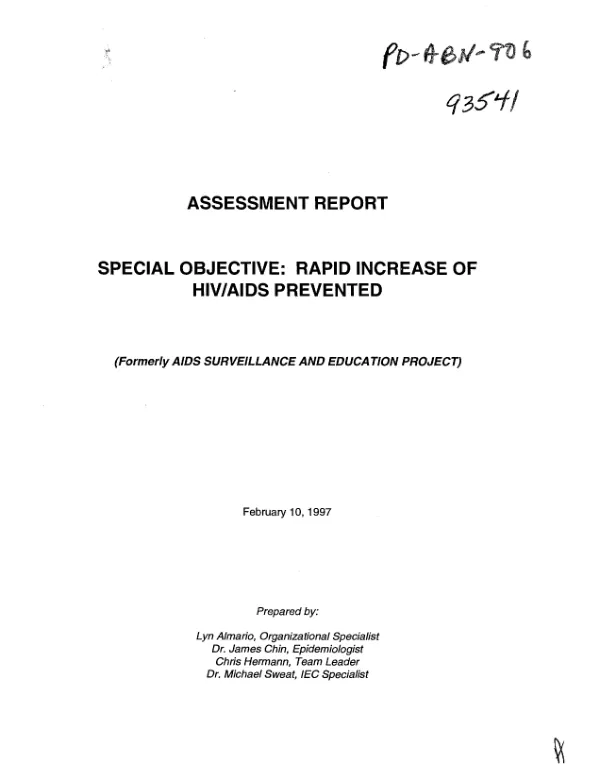
Assessment report -- special objective : rapid increase of HIV/AIDS prevented (formerly AIDS surveillance and education project)
Open record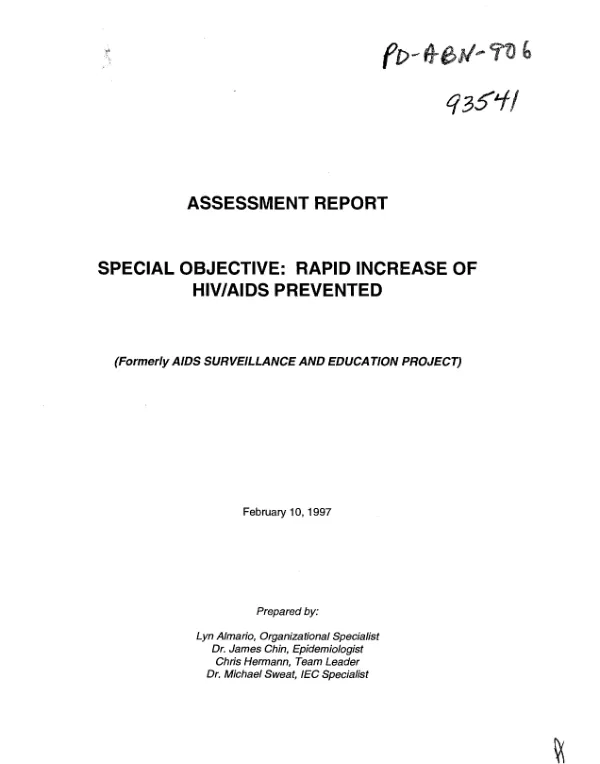 1997
1997USAID DEC