USAID. OFC. OF THE INSPECTOR GENERAL. REGIONAL INSPECTOR GENERAL FOR AUDIT. DAKAR
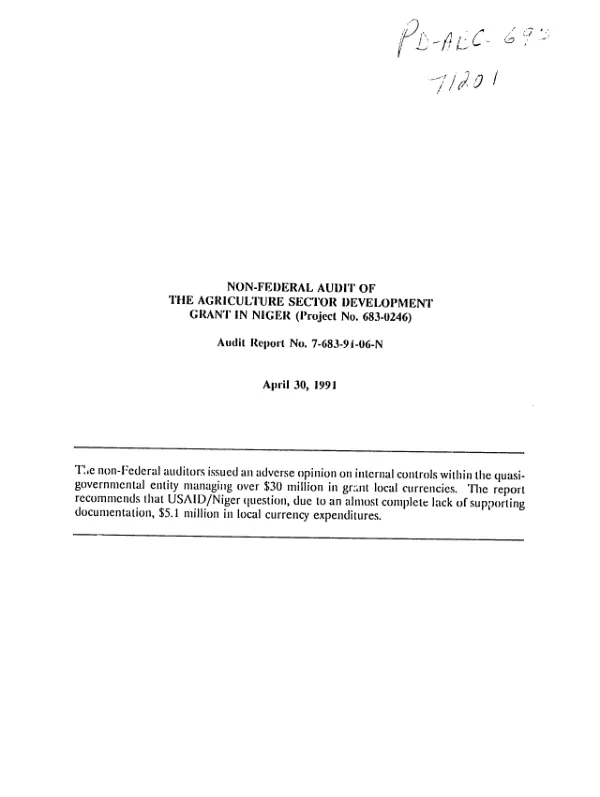
Audit of the agriculture sector development grant in Niger, project no. 683-0246
Audit of a program to provide a cash grant and TA in support of agricultural policy analysis and reform in Niger.
1990
Sign in to readA free account is required to download.
Abstract
The audit covers the period 1984-9/89. Although the host government successfully carried out required policy changes, the program is characterized by a lack of management control and the misuse of funds. The Mission failed to ensure monitoring of counterpart-funded agricultural projects, resulting in very poor utilization of counterpart funds and a total lack of assurance that projects were achieving objectives. The Mission also misused program trust funds for general operating costs, such as vehicles and translators. Counterpart funds were also used to establish an Executive Secretariat to manage the program"s local currency component; this Secretariat, a quasi-governmental entity, is currently also receiving counterpart funds from a Mission health sector grant. The Secretariat has wasted and misused counterpart funds. Specifically, funds were spent on items inappropriate for office operations (e.g., underarm deodorant), items were purchased at inflated costs (carpet at $50 a sq. meter), lax controls resulted in multiple thefts, funds to train Secretariat personnel were used to train outside individuals, and gasoline and project vehicles were being used for nonprogram purposes. Moreover, the counterpart funds were not deposited in a bank account as required, but were held in a Nigerien Treasury account which earned a lower rate of interest, resulting in a loss of $403,000. Also, a delay in the conversion of a $9.5 million tranche of the cash transfer resulted in a $300,000 exchange rate loss and $20,041 in lost interest. The University of Michigan, the TA contractor, did not develop an institution-building strategy for the policy analysis unit as required. As a result, after four years of TA, the unit is still staffed almost entirely with expatriate experts. Finally, the Mission has not yet established a methodology for assessing the program"s impact. It is recommended that Phase II not be funded until a methodology for measuring impact is firmly established and that the Secretariat be decertified until administrative and financial management controls are instituted. It is also recommended, inter alia, that future cash transfers under both this grant and the health sector grant be deposited in interest-bearing bank accounts and that both grant agreements be revised to assure the timely transfer and conversion of all future cash transfer payments.
![Audit of the quality of MACS [mission accounting and control system] data at USAID/Niger](https://covers.devme.ai/gen/13512.webp)