ACADEMY FOR EDUCATIONAL DEVELOPMENT, INC. (AED)
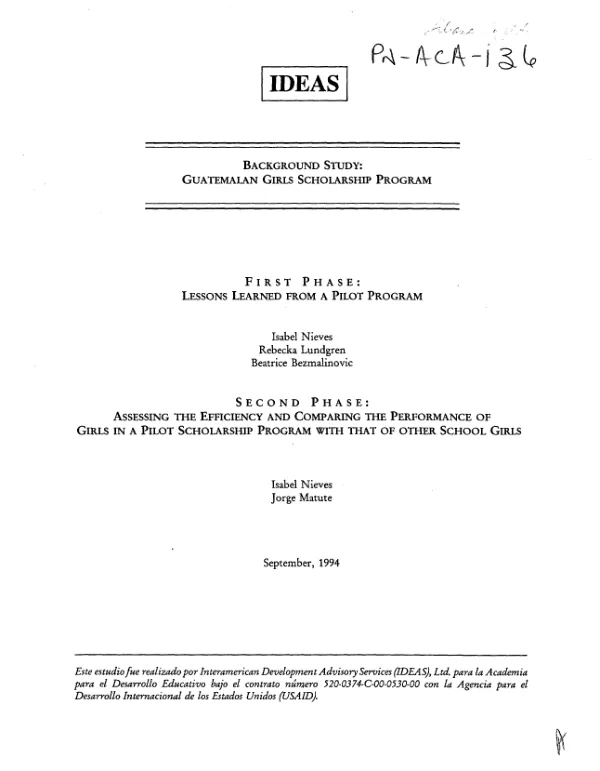
Background study : Guatemalan girls scholarship program
The Guatemalan Association for Sex Education (AGES), a Guatemalan NGO, has operated a pilot scholarship program for elementary schoolgirls in 13 Mayan communities since 1987.
Nieves, Isabel; Lundgren, Rebecka · 1994
Sign in to readA free account is required to download.
Abstract
The program, the only one of its kind in Guatemala, provides economic contribution to girls" families, academic and psychological support for students, guidance for parents, encouragement for teachers, and uses community-based social promoters. This study examines the pilot scholarship program in order to identify those components that are essential to the success of any scholarship program for primary girls. The first part of the report describes the AGES scholarship program"s history and principal interventions and the results of a qualitative analysis of the program in terms of coverage, failure, and dropout rates and the factors governing repetition, dropout, and retention. Lessons learned in the course of implementation are detailed. The second part of the report presents a quantitative comparison of 950 scholarship recipients with approximately 6,000 schoolgirls, similar to scholarship recipients in every characteristic except participation in the scholarship program. Main findings of the study were as follows. (1) Generally, scholarships promote school retention among girls; "school efficiency" ratio (the proportion of grades successfully completed per year of school attendance) of girls on scholarships is high, even among younger scholarship recipients, although the ratio was even higher for those in later grades. (2) School efficiency improved most among younger girls who received their first scholarships when they entered preschool or first grade. The efficiency of older girls in higher grades is not appreciably improved by scholarships. (3) Repetition and drop-out among scholarship recipients is explained by insufficient time for schoolwork at home, lack of parental support, disillusionment with grade failure, seasonal migration, and illness. Among older girls, work for income and the onset of male-female relations are also significant determinants of educational success. Among the younger set, large class size, an unfamiliar and monolingual school environment, and lack of knowledge of the dominant language are contributing factors. (4) Family background variables such as number of siblings, parental education, and religion make no statistical difference in the success of scholarship beneficiaries in terms of efficiency. However, having an older sister who attended school can help a girl adapt to the school environment and help her secure her family"s support. (5) A high degree of internal social cohesion, strong traditional organizations, little seasonal migration, community support for program activities, and good relations between school officials and townspeople are crucial to the success of the scholarship program. Recommendations are made for: enhancing the retention of girls in elementary school; improving school efficiency of girls in elementary school; selecting community and families to participate in scholarship programs; and improving the chances of success and discouraging repetition and drop-out among scholarship recipients. Includes references.


![Curriculum development and research in NWFP [Northwest Frontier Province] : a status report and organizational study](https://covers.devme.ai/gen/22391.webp)