USAID DEC
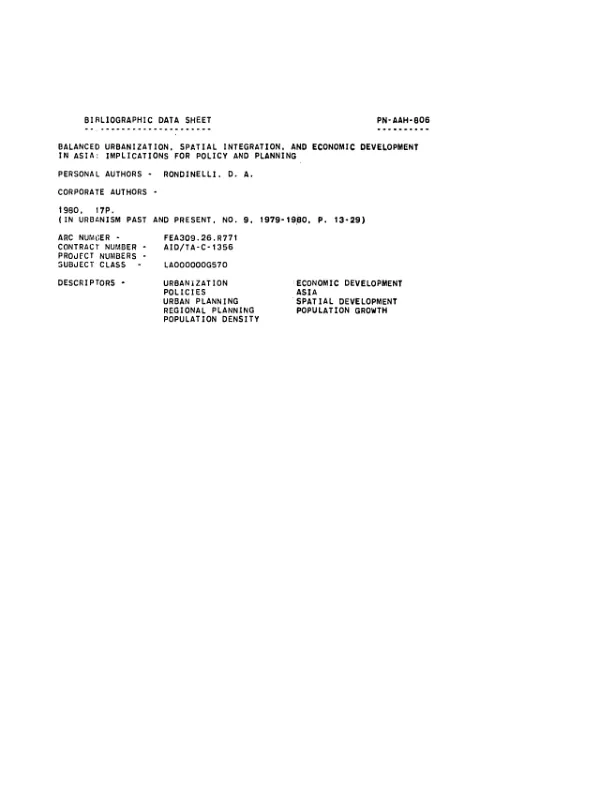
BALANCED URBANIZATION, SPATIAL INTEGRATION, AND ECONOMIC DEVELOPMENT IN ASIA : IMPLICATIONS FOR POLICY AND PLANNING
Sign inUSAID DEC
BALANCED URBANIZATION, SPATIAL INTEGRATION, AND ECONOMIC DEVELOPMENT IN ASIA : IMPLICATIONS FOR POLICY AND PLANNING
Although 12 of Asia"s metropolitan centers are among the world"s 35 largest cities, and half of all Asians are expected to be urbanites by the year 2000, this report on urbanization and spatial patterns in East and Southeast Asia argues that it is not the pace but the pattern of urbanization which poses problems for developing countries.
RONDINELLI, DENNIS A. · 1970
Sign in to readA free account is required to download.
Abstract
Asian nations are characterized by pervasive economic dualism and spatial polarization because past development efforts and investments have favored primate cities (the main urban center, usually the capital), and "trickle down" processes have failed to spread to rural areas. Tendencies toward polarization originating in the colonial era have become self-perpetuating, further aggravating the situation. As a result, primate cities are now islands of modernization dominating over secondary cities and stagnant rural areas. Migration from rural to urban areas reenforces this primacy. The pace of urban growth in Asia is fast and increasing, but most primate cities are severely limited in their ability to absorb larger populations without creating or exacerbating such problems as extensive slums, large-scale employment, air pollution, and strained public facilities. Although some theorists argue that as economic growth accelerates, equity problems will be ammeliorated and spatial polarization will be reversed automatically, this author argues that a deliberate strategy of decentralized urbanization is needed to disperse urban growth, accelerate rural development, and promote and absorb development inpulses already strong in primate cities. Such a policy must aim to: (1) maintain and improve critical services and facilities in metropolitan centers; (2) control growth in the primate city; (3) stimulate growth of regional metropolitan areas and intermediate-size cities; (4) strengthen existing and incipient market towns as rural service centers; (5) create strategic villages as agricultural service centers; (6) tie decentralized urbanization policies to integrated rural development programs; and (7) strengthen the linkages among settlements in regional and national spatial systems.