ABELES SCHWARTZ AND ASSOCIATES, INC.
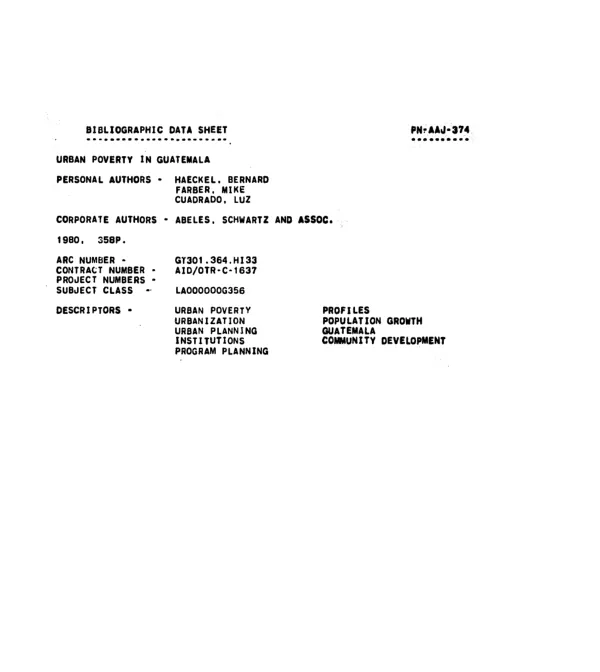
URBAN POVERTY IN GUATEMALA
Guatemala"s urban poor may be better off materially than her rural poor, but they feel poorer because of the stark contrast between themselves and the urban rich.
HAECKEL, BERNARD; FARBER, MIKE +1 more · 1970
Sign in to readA free account is required to download.
Abstract
This study examines the characteristics and distribution of urban poverty in major Guatemalan cities and the measures being taken to alleviate this poverty. Included are a brief analysis of the major population shifts contributing to urban poverty in Guatemala; a profile of the urban poor, their work, income, expenditures, homes, and perceptions; an analysis of key institutions serving the urban poor, with emphasis on the access of the poor to the benefits of public programs; and a brief review of spatial trends in public investment. Over the past 30 years, population has grown almost twice as fast in Guatemala"s cities as in her rural areas, largely because of migration from rural areas and smaller cities, with the focal point of growth being Guatemala City. A majority of the urban poor work in small-scale industry, especially construction, and income from formal work is often supplemented by side jobs. Evidence, while sketchy, suggests that income distribution is among the most unbalanced in the hemisphere. In addition, the construction of minimum-standard urban shelter currently reaches only 25% of the current national goal of 26,000 units. Those not serviced by public or private housing resort to squatting on the outskirts of urban areas or to building their own shelter from precarious materials in areas providing little access to public water and disposal services. The ability of city governments to render municipal services required by law (potable water, sewers, street cleaning) suffers from several major institutional weaknesses, including poor coordination of public services, undefined responsibility for planning, poorly qualified personnel, an inadequate system of municipal finance, and a lack of citizen participation. The 37-fold increase in public investment over the past 9 years has focused mostly on agriculture, transportation, energy, and health, with investments largely concentrated in the Department of Guatemala and in the Southern Departments of Escuintla and Santa Rosa. Housing and education have received only modest attention. Survey data and a 59-item bibliography (1972-80) are included.