USAID. MISSION TO PAKISTAN
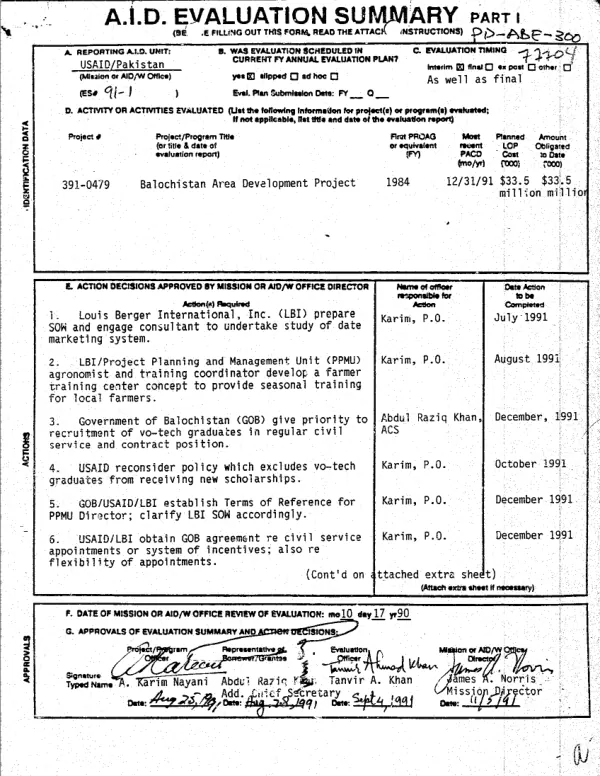
Balochistan area development project
Summarizes attached evaluation (XD-ABE-300-A) of a project to integrate the Makran Division in Balochistan, Pakistan, into the country"s economic mainstream.
1991
Sign in to readA free account is required to download.
Abstract
Final evaluation covered the period 1984-9/90, over a year prior to the 12/91 PACD. After a slow start under isolated and difficult conditions, the project has established itself as an important agent for development in Makran. Achievements have been mixed, however. On the positive side, the Kech Bridge and over 300 km of roads have been upgraded, 178 priority irrigation projects have been completed throughout the Turbat and Panjgur districts, and agriculture activities are off to a good start, with 350 farmers participating in on-farm demonstrations of new varieties and cultivation methods. The building of additional primary school classrooms under Special Development Activities also stands out as a positive achievement. On the debit side, the Communication and Works (C&W) Department"s ability to maintain roads needs improving; a comprehensive hydrogeological survey is needed to determine the appropriateness and longer term consequences of water interventions; agricultural efforts tend to be without reference to any overall government planning framework; and the highly touted Vo-tech Training Program was deemed a failure due to its low job placement rate for returned students. Also, other than classrooms for girls, nothing has been done to address the special needs of women. Efforts to institutionalize the project, in particular to establish the project planning and management unit (PPMU) as an integral part of Balochistan"s Planning and Development Department, have had limited results. Long delays by the Government of Balochistan (GOB) in empowering and staffing the PPMU raised concerns about the GOB"s commitment to decentralizing development planning, and project is still a contractor operation, with the PPMU tacked on as an adjunct. Successes in implementing road and water sector infrastructure can be credited mainly to the contractor, Louis Berger International, Inc. The deobligation of $11.5 million due to the Pressler Phase Out has voided a planned follow-on project (to focus on participatory development, women in development, and the private sector), and also limits the possibilities for addressing evaluation recommendations. Special efforts will be made during the remainder of the project to support indigenous PVO"s in order to promote the concepts of self-help and participation among beneficiaries.
Related documents
![Balochistan area development project [: evaluation]](https://covers.devme.ai/gen/40227.webp)
![Balochistan area development project [: evaluation]](https://covers.devme.ai/gen/8350.webp)