USAID. MISSION TO PAKISTAN
Northwest frontier area development project
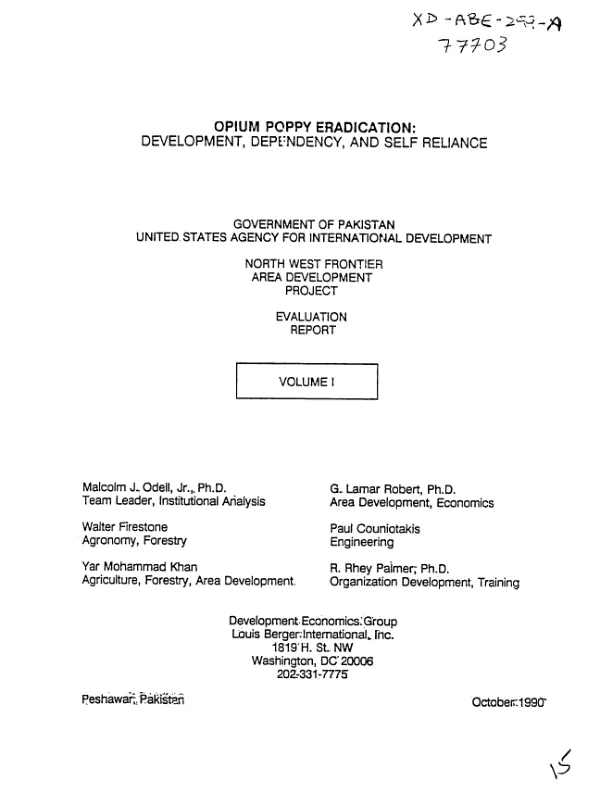
Summarizes mid-term evaluation (XD-ABE-229-A) of a project to eradicate opium poppy in, and develop and diversify the economy of, the Gadoon-Amazai area of Pakistan"s Northwest Frontier Province.
1992
Sign in to readA free account is required to download.
Abstract
The evaluation covered the period 1986-1990. Results are mixed. A unique combination of enforcement and development on the part of the Government of Pakistan (GOP) and USAID/P has succeeded in eliminating virtually all poppy production in the project area, and has brought this remote tribal hill area into the mainstream of Pakistan"s national economy. However, the project has created a dangerous welfare syndrome by providing crop subsidies and orchard and forest payments and by developing infrastructure with little or no community involvement. So far, 400 subprojects have been completed and 600 more begun. Specifically, the project has: (1) built 74 miles of road bringing in goods and services to a previously inaccessible area; (2) constructed 153 schools, 9 health facilities, and 16 veterinary dispensaries; (3) electrified 40 villages; (4) built more than 300 irrigation systems and 163 potable water supply systems; (5) increased crop production 50% by introducing high- yielding varieties and fertilizer; (6) trained more than 2,000 local residents in technical trades; (7) placed more than 3,000 local residents placed in new jobs; and (8) moved more than Rs. 400 million through the local economy via subsidies, cash payments, and employment generation. Despite these achievements, which in fact have benefitted relatively few, the Gadoon-Amazai area still lags behind the adjacent Swabi lowlands in terms of basic infrastructure and social services and will continue to do so even if the 600 subprojects currently in the pipeline are completed. Weak linkages to key line agencies further threaten project sustainability, including the maintenance and operation of facilities. Three lessons were learned. (1) A project of this type should include more community participation. (2) Subsidies should be phased out early and self-help activities should be implemented by a social service team to avoid dependency. (3) Subsidies should not be as high in future projects of this type.
![Local development II [LD II], 263-0182](https://covers.devme.ai/gen/36480.webp)