USAID DEC
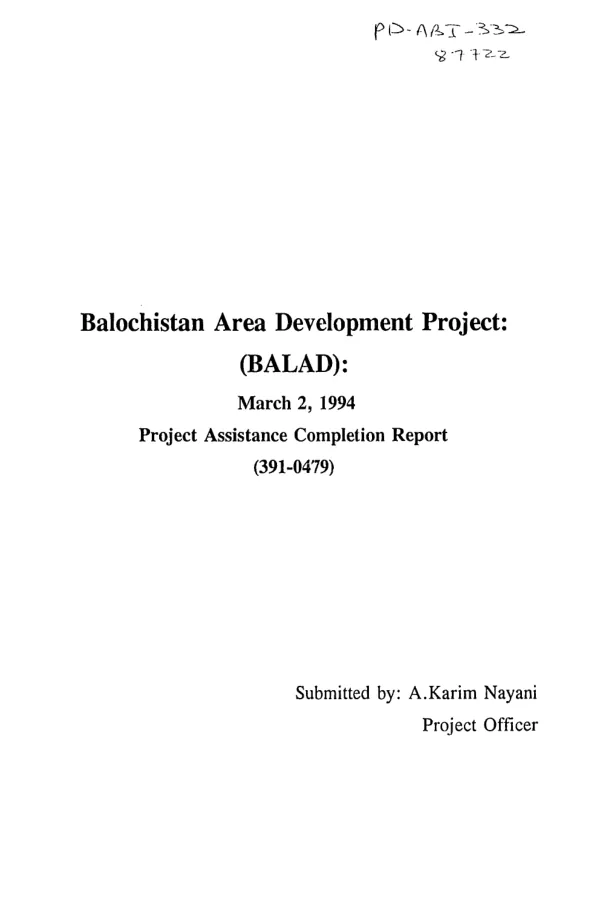
Balochistan area development project (BALAD) : project assistance completion report (391-0479)
Sign inUSAID. MISSION TO PAKISTAN
Balochistan area development project (BALAD) : project assistance completion report (391-0479)
PACR of a project (8/84-6/92) to develop Makran Division in Pakistan's Balochistan Province and integrate it into the country's economic mainstream.
Nayani, A. Karim · 1994
Sign in to readA free account is required to download.
Abstract
Despite a very slow start under isolated and difficult conditions, the project made many concrete improvements from which the Makran people will continue to reap benefits for years to come. The project completed the Ketch River bridge, a highly visible and politically important project which provides an all-weather link to Turbat, and improved the Talar Gap pass, removing a major road bottleneck between Turbat and Gwadar. It also rehabilitated and maintained roads; constructed water systems, including dam spills to recharge aquifers, which should last for many years with little or no maintenance; and made karez and korjo improvements, which will be maintained by private owners. Agricultural practices have been improved on a sustainable basis, and new plant varieties were introduced with a high degree of receptivity and cooperation from farmers. Farmers and extensionists received training in vine pruning and propagation, date pollination and bunch thinning, fertilizer use, and plant spacing. The project supported personnel development for line agencies and the private sector; constructed schools and a maternity home; developed a computerized project management information data base; and trained Communication and Works (C&W) staff in equipment management. Decentralization of planning and development was initiated, and a framework for regional planning was established. The project also strengthened to a limited degree the Government of Balochistan's planning and management. The following lessons were learned. (1) Even with the provision of TA, training, and equipment, there was little improvement in the performance of Makran's governmental departments, which have failed to maintain equipment, and which are continuing to undertake projects in an ad hoc manner. (2) Frequent transfers of government employees are detrimental to project continuity and sustainability. (3) The project's initial phase stressed visible outputs over institutional development. The 12/90 work plan integrated physical outputs with institutional ones, including training. However, because of an almost 25% reduction in funds stemming from the Pressler Amendment, the work plan was scaled back dramatically, thwarting its major objectives.
Related documents
![Balochistan area development project [: evaluation]](https://covers.devme.ai/gen/40227.webp)
![Balochistan area development project [: evaluation]](https://covers.devme.ai/gen/8350.webp)