USAID DEC
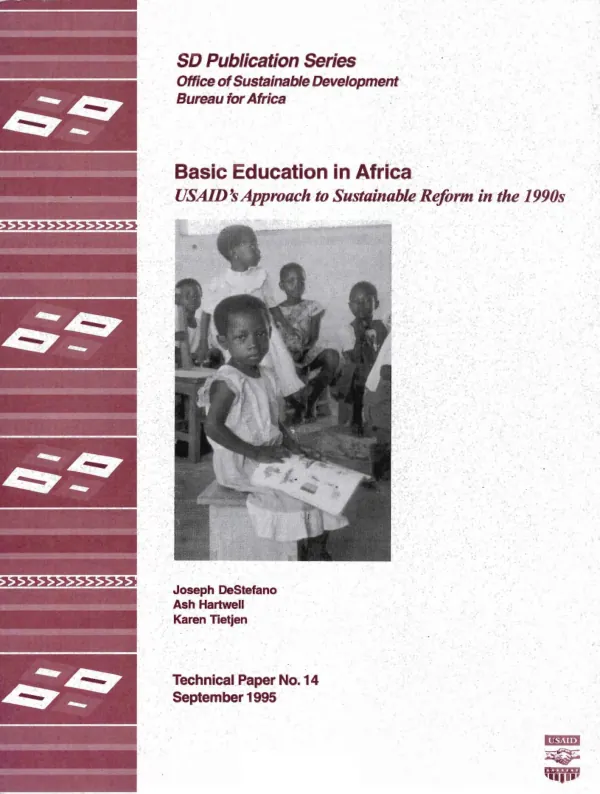
Basic education in Africa : USAID"s approach to sustainable development in the 1990s
Sign inUSAID. BUR. FOR AFRICA. OFC. OF SUSTAINABLE DEVELOPMENT
Basic education in Africa : USAID"s approach to sustainable development in the 1990s
Prior to 1988 the typical USAID education project in sub-Saharan Africa focused on direct beneficiary assistance such as the provision of textbooks to students.
DeStefano, Joseph; Hartwell, Ash +1 more · 1995
Sign in to readA free account is required to download.
Abstract
However, since that time and in light of evidence that direct assistance is not highly sustainable, USAID has utilized a new approach, Education Sector Support (ESS), to help African education systems to identify and remedy their own problems. The ESS approach supports national or government-led sector reform; provides budgetary support conditioned on performance; promotes systemic educational change; focuses on institutional development; stresses the importance of donor coordination; and seeks measurable results in student access and performance. Most ESS programs are based on nonproject assistance (NPA), often supplemented with limited TA and training. This report, a preliminary examination of the impact of ESS, finds that the approach has increased resources for education, particularly at the primary level; improved management practices, including more transparent budgeting, accounting, and personnel systems; institutionalized planning, monitoring, and evaluation functions to chart and track the impacts of reforms; and decentralized management responsibility to encourage greater regional and community involvement in schools. However, ESS, which requires that USAID relinquish control of projects and which does not quickly reveal improvements at the student/school level (these are not likely to be seen in just 5 years" time), has been controversial. However, the paper concludes, despite the arguments of its opponents, ESS is a sound strategy whose successful implementation will require profound changes in project management. Part I describes the ESS approach and NPA strategy in light of research literature on education reform, while Part II compares USAID"s expectations with the impacts of ESS programs in 12 countries, with attention to issues of design, management, and evaluation. Part III evaluates the soundness, underlying premise, and conditions necessary to the success of the ESS approach. The future role of donor assistance and operational research are explored in Part IV. Includes references.
Related documents