USAID. MISSION TO ZAIRE
Basic rural health
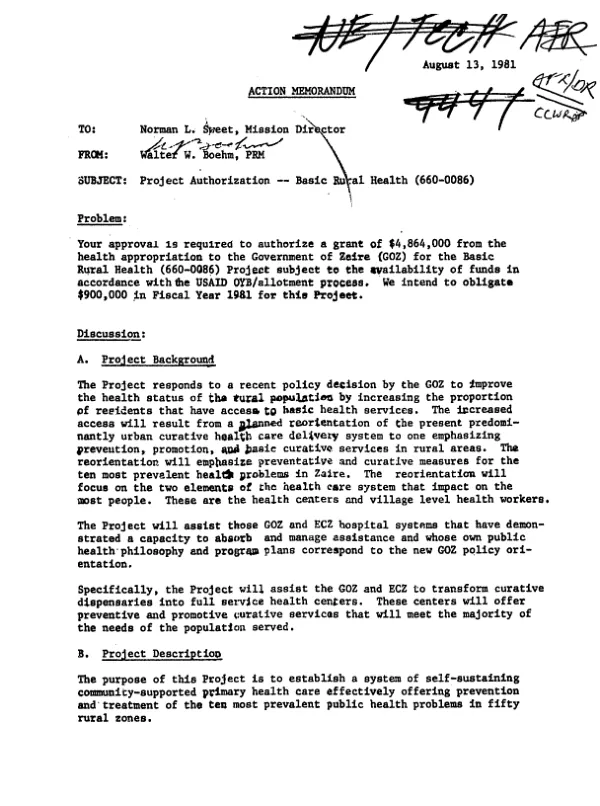
Project to establish in 50 rural zones of Zaire a self-sustaining, community-supported, primary health care system to prevent and treat the 10 most prevalent public health problems.
1981
Sign in to readA free account is required to download.
Abstract
The Church of Christ in Zaire (ECZ), a consortium of Protestant missions, will implement the project, which focuses on building community health centers (CHC"s) and training village health workers (VHW"s), with TA from USAID/Z and the Peace Corps. Under the direction of a zonal hospital, 250 full service CHC"s will be built or transformed from existing curative dispensaries. Each CHC, which will serve 10,000-40,000 people via 3,000 health committees, will offer most or all of the following services: health and nutrition education; prenatal and preschool clinics; immunizations (via 1,000 village vaccination programs); curative services for malaria, intestinal parasites, respiratory diseases, and anemia; normal deliveries and referral of high-risk pregnancies; and family planning. Regarding the latter, which is expected to lead to 150,000 new acceptors, the project will provide 20 laparoscopes to enable hospitals to perform tubal ligations. CHC"s will also teach villagers basic environmental sanitation and will finance community-built sanitation systems (1,500 water systems and 30,000 latrines). The project will also establish, under the direction CHC"s and VHW"s, 1,000 pro-pharmacies stocked with the basic medicines needed to treat the most common health problems. To help attain this end, a system adapted from three existing prototype hospital systems in Zaire will be established to train/retrain current personnel and to identify and train VHW"s. Training will be provided to 2,730 persons, including 750 nurse/midwives, 400 traditional midwives, 50 physicians, 30 community health planners and educators, and 1,500 VHW"s; trainees will be equipped with basic commodities, especially those that can be maintained easily after the project. Also, long-term participant training will be provided to 30 persons and short-term U.S. or third country training to 55. Finally, the ECZ Medical Bureau in Kinshasa will establish a formal mechanism to allow participating hospitals to share and benefit from each other"s experiences.