USAID. MISSION TO BELIZE
Belize livestock development
Summarizes midterm evaluation (XD-ABG-139-A) of a project to upgrade Belize"s livestock sector.
1993
Sign in to readA free account is required to download.
Abstract
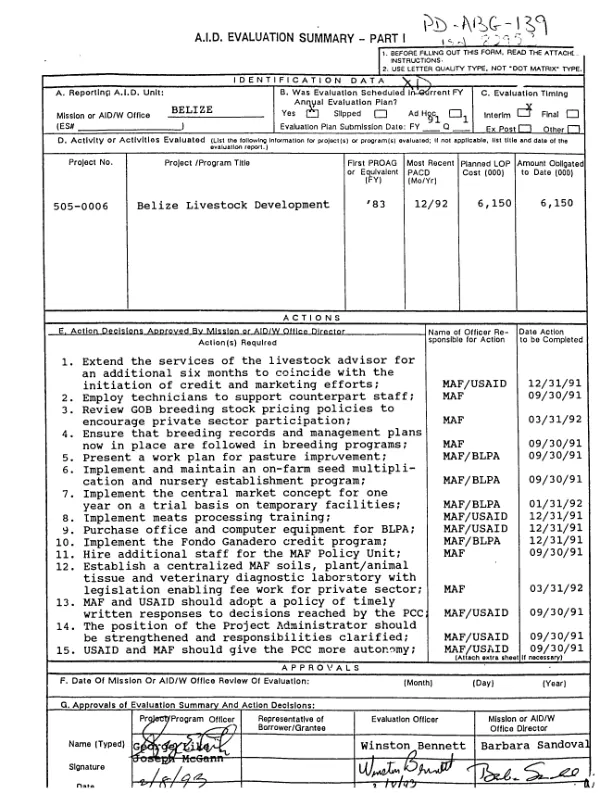
The evaluation covered the period 12/88-4/91. The project design remains valid, although external factors may make some targets (e.g., a 30% increase in pork production and a 10% annual increase in quality beef exports) unrealistic. Internal rates of return will also be lower than projected, but not so as to warrant changes in project design. Progress across components has been uneven. In the pasture management component, training, field demonstrations, nursery establishment, and information dissemination are on or ahead of target; this component is contributing to Belize"s environmental integrity by promoting intensified use of existing pastures rather than forest clearing. The livestock production component is on schedule; achievements include genetic improvement of the Ministry of Agriculture and Fisheries" (MAF) cattle and swine herds through artificial insemination and imported breeding stock. Screwworm eradication, which will benefit wildlife populations as much as livestock, is ahead of schedule and at a lower than projected cost; Belize could be declared screwworm-free by 1/92. In addition, end-of-project targets for economic/analytical policy studies have been met and the studies have contributed to the national debate; efforts to improve the agricultural data base and strengthen the Policy Unit have been less successful. Lack of progress in other areas is partially attributable to the excessive demands made on the project advisors (who generally have performed well given the time constraints imposed by the project design and the contracting firm"s ambitions). The planned pilot central livestock marketing facility is not economically justifiable at present (though it may be justified on development grounds); failure to provide training and support for meat processors has also negatively affected the marketing component. The component to strengthen laboratory facilities is constrained by lack of Government of Belize (GOB) support; combining several laboratories into one facility may be a way around this problem. The Project Coordinating Committee (PCC), created to increase private sector participation in the livestock industry, has done well in reaching decisions on action programs but, being an advisory body, lacks the authority to implement them. USAID procurement guidelines and personnel turnovers and delays in GOB decisionmaking and funding have led to the same delays the PCC was created to prevent. For the most part, women have not been meaningfully involved in the project, and there seems to be no mechanism on the part of the GOB or the Belize Livestock Producers Association (BLPA) for involving them -- despite official policies of nondiscrimination. Sustainability is a major concern for the livestock and pasture components, and will depend on the GOB"s willingness to replace external assistance. Despite training successes, the absence of technicians to assume a portion of counterparts" routine duties severely dilutes their present effectiveness and robs the MAF of potential replacements if these counterparts depart or assume other duties. By contrast, adequate planning and provision of support for the screwworm eradication program seems to ensure its continuity. The project teaches that: (1) Project designs should specify implementation responsibilities and funding sources and make project managers accountable with a minimum of micromanagement from USAID and the GOB. (2) Contract employees should be used to supplement counterparts so as to meet targets; negotiations can be carried out before the end of the project for additional permanent positions to sustain project outputs. (3) BLPA strengthening is a long-term effort which cannot be modeled on other producer associations, since BLPA essentially operates with volunteer staff.
Related documents