USAID. MISSION TO BELIZE
Belize livestock development project
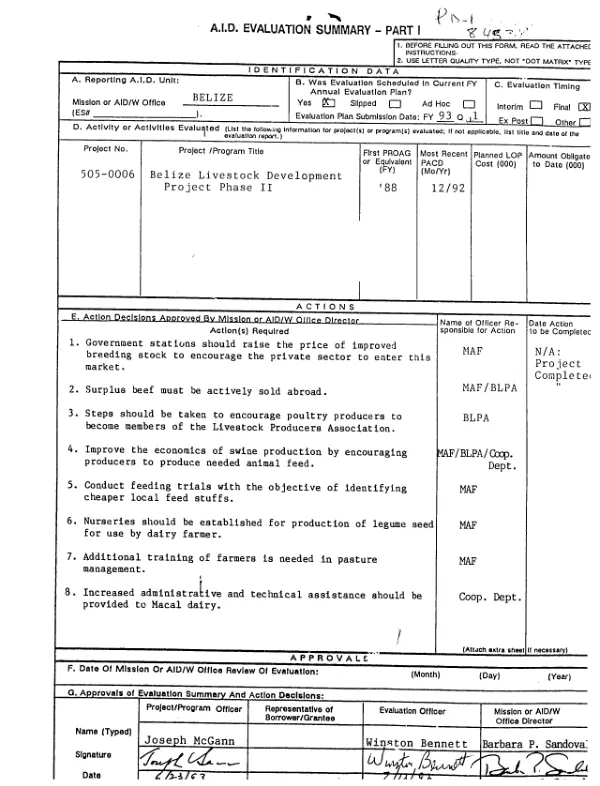
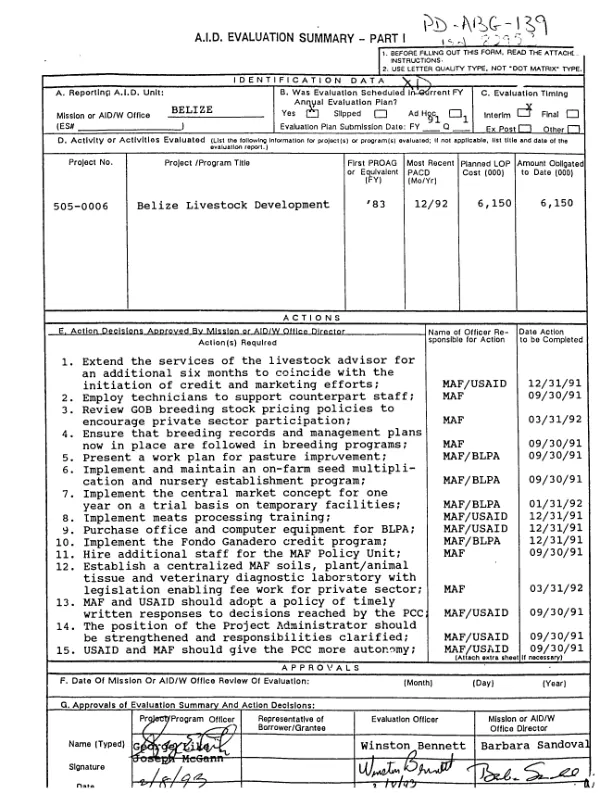
PES of mid-term evaluation (unattached) of project to help the Government of Belize improve livestock production and expand markets.
Willmore, Alyn; Neal, Rodney · 1986
Sign in to readA free account is required to download.
Abstract
Evaluation covered the period 8/83-10/85 and was based on site visits, document review, and interviews with USAID/B and Ministry of Natural Resources (MNR) personnel, advisors, and farmers. Overall success has been seriously hindered by constraints such as small, insecure markets and the high cost of production inputs, and neither swine nor pasture improvement is expected to meet targets. The project"s large focus has diluted efforts, and concrete results will be elusive due to the casual linkages between inputs and outputs. However, livestock remains a high agricultural development priority, and, with swine and pasture TA refocused, greater success is expected. Swine improvement has been hampered by high feed cost (design was based on an artificially low price), the price structure for pigs (kept low by government piggeries), and poor coordination in implementation. Efforts to create a village infrastructure for pig production in the Toledo district, a major producing area, have thus been terminated (savings will be distributed among other components). TA will focus more directly on the linkages (between producers, processors, etc.) necessary to establish a viable industry in the remaining 9 months, and the heretofore dormant revolving fund will be initiated. Pasture improvement has made slow progress; the advisor to the national agricultural research station left early for health reasons, and seeds for nurseries were unavailable in time for planting. TA will focus on farmers" fields (especially for dairy farmers). Extensionist training is on schedule, but MNR resources are limited. Information should be collected on the benefits of improved pasture. Construction of a dairy plant to help the MNR and the Macal Dairy Co-op explore fresh milk demand is behind schedule, delaying the demand study (expected to begin in 5/86; TA will be extended). Producer/butcher training to develop a pork and beef meat processing capability has run smoothly. An MNR policy office is operational, having overcome problems fitting into the MNR structure, and participant training for MNR staff is on schedule (a dairy student will go to the United States if the milk demand study so recommends). Lessons learned are: (1) the impact of a project is reduced where there is only casual linkage between inputs, outputs, and end of project status and a lack of understanding as to the responsibility of each implementer, and (2) gaps in the design of comprehensive projects should be clearly perceived in order to maximize efficiency in implementation.
Related documents