USAID DEC
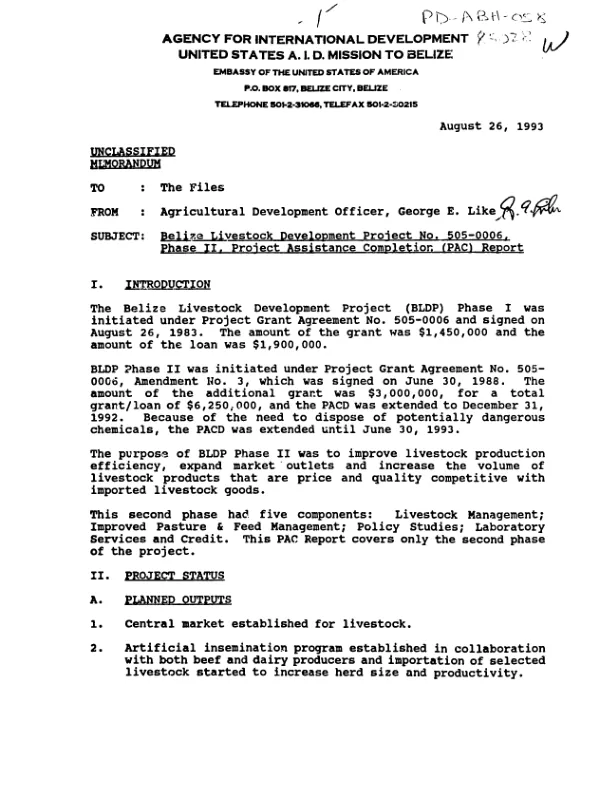
Belize livestock development project no. 505-0006, phase II : project assistance completion (PAC) report
Sign inUSAID. MISSION TO BELIZE
Belize livestock development project no. 505-0006, phase II : project assistance completion (PAC) report
PACR of a Phase II project (6/88-6/93) to help the Government of Belize (GOB) increase livestock production and marketing.
1993
Sign in to readA free account is required to download.
Abstract
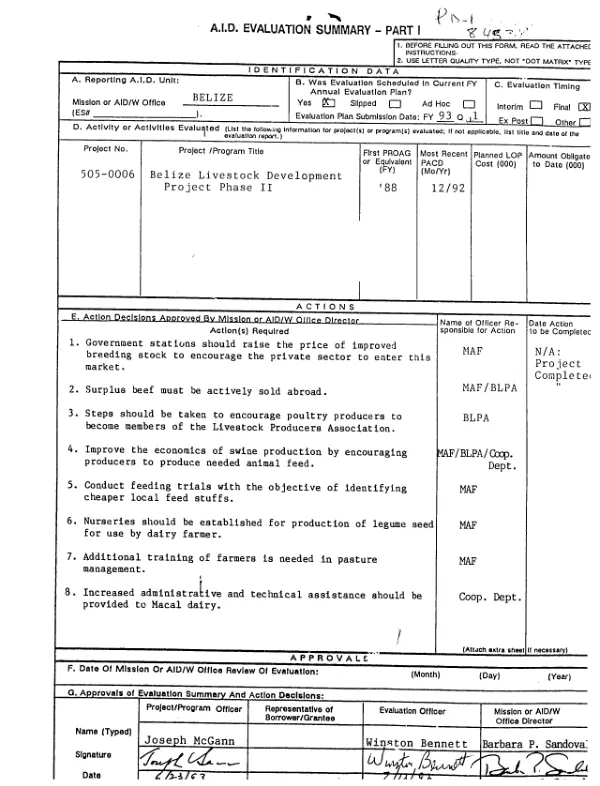
The project has helped to increase livestock processing and expand livestock markets. Beef production is now sufficient to meet domestic needs, along with export of a few live cattle to Mexico. Locally produced pork continues to increase its market share versus imports, but cannot yet meet demand. The Belize Livestock Producers Association (BLPA) and the Ministry of Agriculture and Fisheries are promoting more pork production. The project improved local herds by importing breeding swine and cattle and via an artificial insemination program. The latter was more successful with dairy producers, whom it will continue to support, than with beef producers; the program has been cut back to include only government-owned cattle. The Government of Belize (GOB) continues to support the Screwworm Eradication Program, which has maintained the country's screwworm-free status since 8/92. The BLPA played an active role in the project, directing livestock programs in collaboration with GOB entities. Successful BLPA-GOB collaboration included coordination of private funding for a new slaughter facility; joint marketing trips to Guatemala and Mexico; and the establishment of quarantine and inspection stations at the Guatemalan and Mexican borders. In addition, the BLPA sponsors the Fondo Ganedero Steer-fattening Credit Program, which has placed 534 locally procured feeder steers with 17 farmers. BLPA will also manage the new Central Livestock Market. Construction of the market cost more than anticipated, with additional costs ($58,000) borne by the GOB. Training exceeded expectations. Long-term U.S. training (in animal nutrition, poultry science, and agriculture extension) was provided to 3 persons, and short-term U.S. training to 37. In-country seminars and workshops benefitted over 1,500 farmers. The pasture development program provided training and demonstrations of cost/benefit, weed control, and pasture management; and assisted farmers in the production of grass, legume seeds, and vegetative stock for sale to other farmers. A honeybee rehabilitation program included country-wide workshops on the management of Africanized bees, and the creation of a queen-rearing center which disseminates improved stock to beekeepers. The following lessons were learned. (1) Project design must be clear in determining outputs, assigning responsibilities, and establishing disbursement procedures that are timely yet ensure fiscal responsibility. (2) Provisions should be made to supplement host-country staff shortages due to training and other project-related demands.
![[USDA} Dominican Republic safe agriculture/food export (SAFE) project : midterm evaluation report [FY 2015]](https://covers.devme.ai/gen/1345.webp)
![[USDA] Safe agriculture/food export (SAFE) program - Dominican Republic Project baseline survey : baseline study status of the livestock sector in eleven provinces of the Dominican Republic [FY2015]](https://covers.devme.ai/gen/1344.webp)