BELIZE. MINISTRY OF AGRICULTURE, FORESTRY AND FISHERIES
Review of the Belize livestock development project, phase II
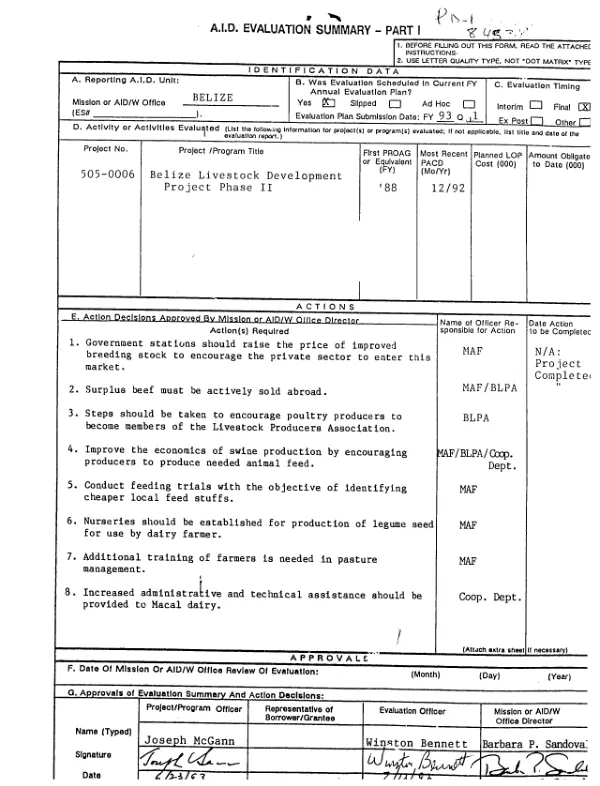
Final external evaluation (XD-ABG-819-A) of a project (1988-12/92) to increase livestock production in Belize.
Rai, B. K. · 1993
Sign in to readA free account is required to download.
Abstract
Of the seven EOPS (end of project status) indicators, four were achieved, one was partially achieved, and two were not achieved. Indicators were met in four areas. (1) In the beef production component, improved Brahman stock were imported, and breeding plans made and computerized. The pasture improvement program introduced new grass species and nurseries and trained farmers in pasture management. As a result, beef production continues to meet domestic supply requirements. However, exports dropped with the closure of the Belize Meats Ltd., the beef exporting company, so that production increases did not lead to increases in farmer income. In fact, if the present surplus of cattle is not exported, prices will actually drop. (2) Personnel development at the Ministry of Agriculture and Fisheries (MAF) functioned very well. Three MAF staff members obtained B.S. or M.S. degrees, and 32 persons, mostly MAF staff, received short-term training abroad in different livestock disciplines. Seminars and demonstrations provided training to 1,238 participants in extension methodology, pasture management, cattle management, dairy management, cattle breeding, artificial insemination, swine management, poultry production, and beekeeping. In addition, training and equipment were provided to the Soil and Tissue Analysis Laboratory and the Veterinary Clinic and Diagnostic Laboratory at the Central Farm. Funds were lacking, however, to operationalize the pesticide residue analysis laboratory. (3) In furtherance of the goal to increase the private sector's role in the livestock industry, the project helped the Belize Livestock Producers Association (BLPA) add new activities, including management of a credit program for fattening steers and management of the new Livestock Central Market (LCM). The roles of MAF and private sector have become distinct while working together for betterment of the livestock industry, although BLPA's limited financial resources constrain it from assuming a greater role. (4) The screwworm eradication program was a success. On June 21, 1992 Belize was declared free of screwworm and remains so to this day. The marketing and credit component was partially successful. A market assessment for Belizean cattle and beef was conducted in CARICOM countries, Mexico, and the USA, and the project assisted in the construction of a facility to export live cattle to Mexico. Furthermore, the LCM, expected to become operational in April 1993, will assist in marketing of all livestock. The project also helped establish credit for fattening of steers by farmers (Fondo Ganadero). Credit for pork and milk production was not considered. Two EOPS indicators were not achieved. (1) Domestic pork production did not increase. The number of pigs slaughtered each year from 1988 to 1992 remained constant, and the demand for pork by processors remained unsatisfied. On the positive side, the project: imported breeding stock, developed breeding plans, computerized swine records, and trained farmers in production. The analysis of feeder pig production in private sector, as recommended in Project Paper, should have been given priority in efforts to increase pork production. (2) The target to increase milk production was also not met. The amount of milk purchased by Macal, the processing plant, dropped about 20% after 1989 and remained at about one third of the processing capacity of a single shift. Project activities in the dairy sector included: development and revision of operational and management plans for Central Farm and farmers, artificial insemination and training of farmers. The problem is not the lack of milk cows but internal management problems at Macal.
Related documents