USAID DEC
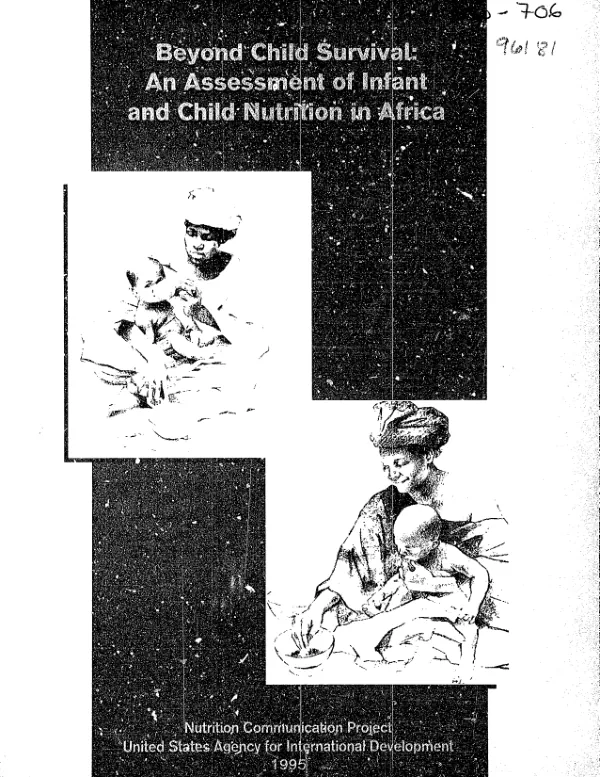
Beyond child survival : program options to benefit infant nutrition in sub-Saharan Africa
Sign inACADEMY FOR EDUCATIONAL DEVELOPMENT, INC. (AED)
Beyond child survival : program options to benefit infant nutrition in sub-Saharan Africa
Due to accumulated knowledge and experience, some of the child health problems that seemed intractable in Africa a short time ago now have affordable solutions.
Fishman, Claudia; Hansch, Steven · 1995
Sign in to readA free account is required to download.
Abstract
This report reviews the state of maternal and child nutrition in Africa in light of recent data demonstrating the effects of nutrition on child survival and long-term development goals. The first part of the report discusses the relationship between malnutrition and child mortality and the relationship between child mortality and high fertility in Africa. Chapter two takes a developmental approach to child survival from preconception to age 5, analyzing data in light of a mother"s ability to: conceive and bear a healthy child (with emphasis on ensuring normal iodine status before pregnancy); nourish that child exclusively with her own milk (covering both the nutritional prerequisites in the mother for, and her actual practice of, exclusive breastfeeding); and to add appropriate complementary foods to the child"s diet, thus allowing the child to mature to school age. discusses the development and delivery of nutrition interventions (including cost data) in Africa. Examples include: community-based growth promotion interventions that decreased the numbers of children suffering from malnutrition in Mali and Tanzania; breakthroughs in weaning-food technology in Nigeria and Gambia; evidence that breastfeeding promotion reversed negative trends in Ghana, Swaziland, and Kenya; nutrition surveillance systems that averted famines in Botswana and Zambia; and the possibility of cross-border collaboration in the production and transportation of iodized salt to eliminate iodine deficiency disorders in southern and central Africa. Includes references.
Related documents