USAID DEC
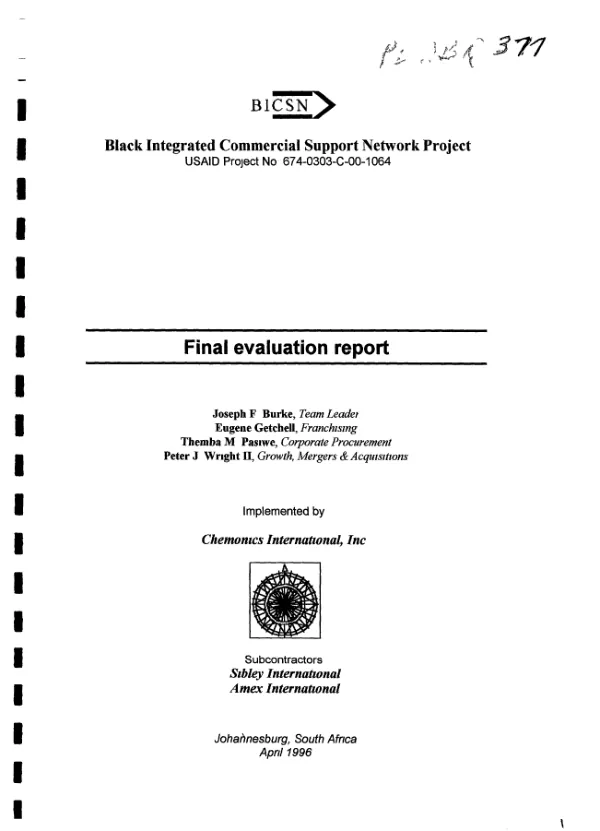
BICSN -- black integrated commercial support network project, USAID project no. 674-0303-C-00-1064 : final evaluation report
Sign inCHEMONICS INTERNATIONAL, INC.
BICSN -- black integrated commercial support network project, USAID project no. 674-0303-C-00-1064 : final evaluation report
Final evaluation of the Black Integrated Commercial Support Project (BICSN -- 1993-4/96), a pioneering effort to promote equitable participation of blacks in South Africa's economy.
Burke, Joseph F.|Getchell, Eugene · 1996
Sign in to readA free account is required to download.
Abstract
The BICSN project as restructured and re-staffed was dynamic, focused, and results-oriented. It succeeded in adhering to its reformulated mission to assist a core of high-potential black enterprises (BEs) achieve accelerated growth and linkages with the large enterprise sector and to function as models for other BEs. It also fulfilled four interrelated objectives to: (1) develop greater access to markets for black-owned enterprises by forging profitable commercial linkages with corporations and other business entities in South Africa; (2) improve the managerial capabilities of targeted BEs; (3) increase long-term employment and wealth creation potential of BEs; and (4) achieve long-term self-sustainability in many targeted BEs by transforming them into professionally managed formal businesses. The project broke new ground by bringing BEs into important business areas from which they had been almost entirely excluded up to the time of majority rule. BICSN therefore was instrumental in opening the formal establishment to the concept as well as the reality of greater economic participation for blacks through its focused products in corporate procurement, franchising and growth, mergers, and acquisitions. Moreover, BICSN has shown that well-conceived and competently executed private-sector-based efforts can have immeasurable impact in paving the way toward a new economic order. BICSN was particularly well served by its three senior executives, who had both the will and the ability to fulfill their mandate. Had BICSN had the resources to hire more educated upwardly mobile South African understudies, the benefits of on-the-job training in BICSN's various technical areas would have been of even greater significance to long-term sustainability. The reorientation of the project's TA Fund, or TAF, to a client co-payment for technical services is viewed by the evaluation team as a sound approach and proved to be a useful filter to determine the seriousness of prospective clients. BICSN clients were equally well served by the project's extensive program of conferences, seminars, and workshops. Given the resistance of the South African business environment, BICSN's equity fund component was unfulfillable as planned. The lack of equity moneys represented a continuing constraint to the project and limited its impact in many areas. Nevertheless, BICSN went on to succeed and to pave the way for a USAID follow-on equity fund/TA project that will be set in a better time frame and that can benefit from its predecessor's experience. The BICSN experience indicates that future donor efforts of this kind need to create re-flow and recapturing mechanisms, possibly through an assigned trust entity to enable continuing rotation of moneys. Equity fund projects allow especially interesting possibilities for the creation of re-flows. (Author abstract, modified)
Related documents
![SAIBL [South African international business linkages] : evaluation & impact assessment](https://covers.devme.ai/gen/5225.webp)