USAID DEC
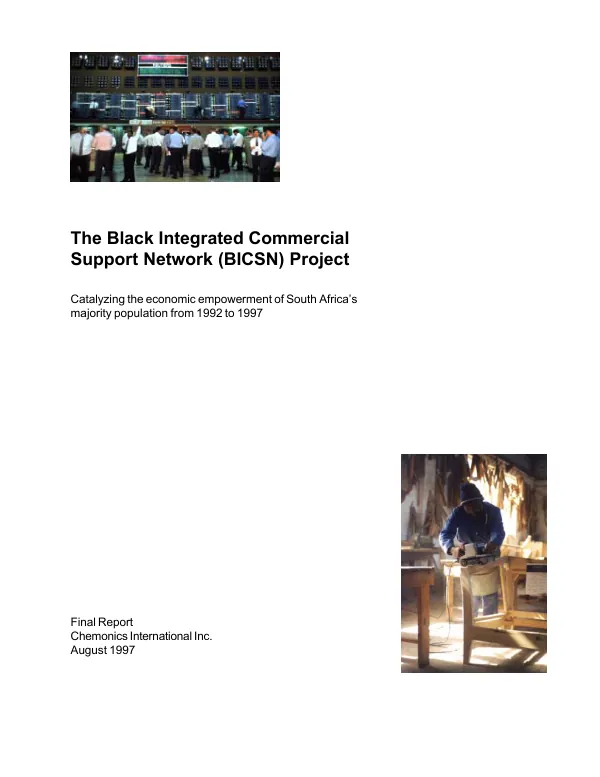
Black integrated commercial support network (BICSN) project : catalyzing the economic empowerment of South Africa"s majority population from 1992 to 1997 -- final report
Sign inCHEMONICS INTERNATIONAL, INC.
Black integrated commercial support network (BICSN) project : catalyzing the economic empowerment of South Africa"s majority population from 1992 to 1997 -- final report
Final report of the contractor, Chemonics International Inc., on the Black Integrated Commercial Support Network (BICSN) project (1992-97), designed to increase the rate of economic empowerment of disadvantaged South Africans by developing and nurturing promising enterprises within the black business community.
1997
Sign in to readA free account is required to download.
Abstract
BICSN got off to a poor start due to a lack of programmatic focus and clearly defined responsibilities. However, in May-June 1993 the project was reformulated under the leadership of a new Chief of Party, began to gain credibility, and, in the end, "delivered the goods." BICSN, which pursued activities in three areas (corporate procurement, franchising, and mergers and acquisitions), focused sharply on high-potential entrepreneurs and businesses, allowing it operate in a largely empty niche among previously disadvantaged group (PDG) business advocacy organizations in South Africa. The project, in cooperation with the National Minority Supplier Development Council (NMSDC), provided its beneficiaries with access to seasoned executives from major U.S. corporations such as Bell Atlantic and Ford Motor Company, who provided expertise in corporate procurement. In addition, through linkages with the International Franchise Association, the Franchise Association for Southern Africa, NAFCOC, and local institutions, BICSN introduced annual franchising conferences that linked U.S. and South African entrepreneurs for the first time. These events had a measurable impact on the business environment, and many businesses have since become largely self-sustaining. At the enterprise level, BICSN TA and training services ran the gamut from business and financial planning to production and quality control, but, in response to a perceived need, focused heavily on control and administrative systems. BICSN has also had an impact on investment activity in South Africa. In 1991, only two PDG-controlled businesses were listed in the Johannesburg Stock Exchange, but by early 1996, the Exchange listed 12, 3 of which resulted directly from BICSN intervention; equity leveraged from these three deals is estimated at $276 million. Moreover, the International Finance Corporation is advancing the project"s equity fund concept through a $30 million Succession Fund that will help PDG entrepreneurs take equity positions in high-growth enterprises, and the BICSN Trust will hold more than R1 million in assets from client copayments and success fees generated under Technical Assistance Fund contracts -- funds that may be used to support future PDG development. In mid 1995, BICSN began to divest responsibility for its activities to various other projects, including USAID"s Business Linkages for Underutilized Enterprises (BLUE) and South African Enterprise Development Fund projects. The Equity Access System (EASY) project has also helped bridge the gap between new equity sources and individual enterprises. The franchising activity was seen as commercially self-sustaining by then and was therefore terminated. The following lessons were learned. (1) Private sector enterprise development projects must be sharply focused, find their comparative advantage in the market place, and provide a consistent set of products to a clearly identified group of clients. (2) Resources to supplement donor funding should be leveraged, but not at the risk of diluting focus. (3) The key to success in complex development assistance projects is the flexibility to responding to changing circumstances. (4) Enterprise development projects should include client co-payments for local consulting services. (5) Involving advocacy groups in BICSN gave South African corporations and associations the opportunity to get ahead of the affirmative action regulatory curve and influence its direction. (6) Franchising offers a low-risk format for PDG enterprise development. However, franchising efforts must be preceded by considerable education of potential franchisors and franchisees and of the financial and professional service community. (7) Sustainable economic transformation is a long-term effort requiring repeated action and unrelenting commitment. (8) Sustainability of PDG business support needs to be well thought out at the design stage and reevaluated periodically. (9) South Africa"s financial markets and investment climate are becoming more receptive to a professionally managed, commercially oriented, "blind" equity fund with a PDG focus. (10) PDG enterprise support activities in South Africa, particularly those with equity fund components, need to take stock of the dearth of mid-level black managers. USAID should support a long-term managerial recruitment and training program to develop PDG managers.
Related documents
Documents in this collection
 1996
1996USAID DEC
BICSN -- black integrated commercial support network project, USAID project no. 674-0303-C-00-1064 : final evaluation report
Open record 2008
2008USAID DEC
![Small entrepreneur empowerment drive [: final report]](https://covers.devme.ai/gen/55201.webp)

![SAIBL [South African international business linkages] : evaluation & impact assessment](https://covers.devme.ai/gen/5225.webp)