ACDI/VOCA
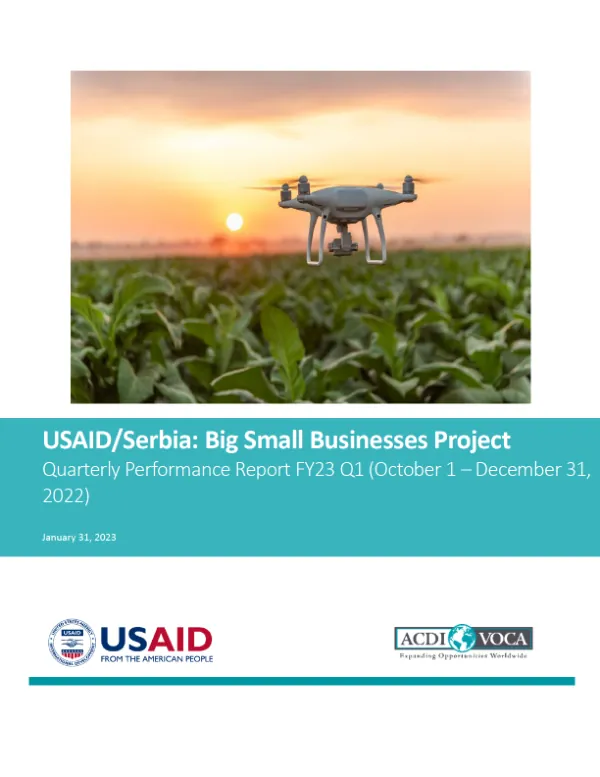
Big Small Businesses Project Quarterly Performance Report FY23 Q1
The Big Small Businesses Project in Serbia continued to implement its objectives during the first quarter of fiscal year 2023.
2023 · 34 pages
Sign in to readA free account is required to download.
Abstract
The project's main objective is to improve the productivity and profitability of small and medium enterprises (SMEs) in Serbia. To achieve this objective, the project focuses on four key areas: improving SME productivity and profitability, expanding SME markets and exports, increasing SME utilization of financing instruments, and developing a skilled and diversified workforce. The project's activities in the first quarter were focused on reviewing and finalizing the Transformational Partnership and Innovation (TPI) Fund Annual Program Statement (APS) and announcing it to the Serbian business community. The project team also organized information sessions to present the procedures and rules for APS application submission and provided clarification and guidance to potential applicants. As a result, 12 TPI Fund applications were officially submitted, and the project team reviewed and evaluated nine of them. Two applications were approved for direct fund support, four were approved for co-creation, and three were rejected. The project has also established a working relationship with the Serbian Chambers of Commerce and Industry (SCCI) and the Agro Belgrade doo, the leading regional fair trade exhibitions organizers. The project signed a Memorandum of Understanding (MoU) with SCCI to add a trade fair for machinery and equipment to the existing SCCI portfolio of international trade fairs. Additionally, the project established the first Youth Rural Business Fund (YRBF) to support agricultural high school graduates in the municipalities of Pozega, Cajetina, and Gornji Milanovac. The project faced some challenges during the reporting period, including geopolitical events that caused an influx of people and professionals from conflict zones to Serbia, resulting in real-estate market disruption and delay in office space lease. The APS process also showed that potential partners need more capacity and time to respond correctly to the call for applications and submit proposals that align with the APS requirements. The project has needed to invest a higher level of effort than expected in reviewing proposals and supporting applicants to articulate their project ideas better. The project's implementation has started to show results on the ground, with four revolving funds established with Serbian municipalities and the development community. One of the funds in Novi Pazar was the host to the Mission Director and USAID team for the launching of the fund. The project's activities have also started to show the first results in terms of improving SME productivity and profitability, expanding SME markets and exports, and increasing SME utilization of financing instruments. The project's monitoring and evaluation plan includes indicators and targets for measuring its progress and impact. The project's budget and expenditures are also being tracked and reported on a quarterly basis. The project's sustainability is being ensured through its partnerships with local organizations and institutions, as well as its focus on developing a skilled and diversified workforce. Overall, the Big Small Businesses Project in Serbia has made significant progress in its first quarter of implementation, with a focus on improving SME productivity and profitability, expanding SME markets and exports, increasing SME utilization of financing instruments, and developing a skilled and diversified workforce. The project's activities have started to show results on the ground, and its implementation is expected to continue to make a positive impact on the Serbian economy.
Related documents