CARDNO EMERGING MARKETS USA, LTD.
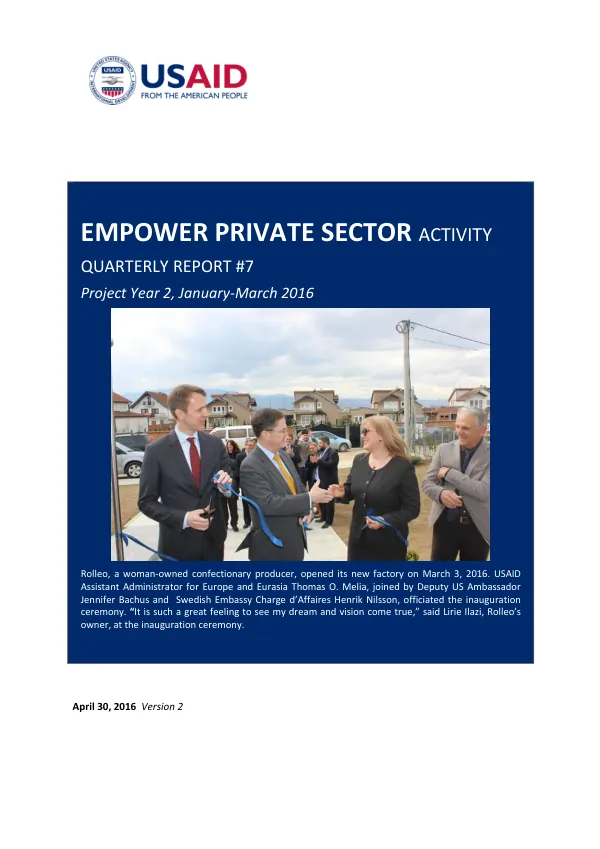
Quarterly Progress Report #7: EMPOWER Private Sector Activity
EMPOWER Private Sector is a USAID-sponsored project dedicated to Kosovo's economic growth.
2016 · 30 pages
Sign in to readA free account is required to download.
Abstract
It began in July 2014, has an expected term of five years, and an original budget of approximately $10 million. The Project has a staff of 16 (plus 5 interns) and is headquartered in Pristina, with a branch office in North Mitrovica. It is implemented by Cardno Emerging Markets, with subcontractors Crimson Capital and RTC Consulting. The Project's overarching objective is job creation, which comes from businesses that have growing sales and need to increase their employment in order to produce more goods and services for the market. To support job creation, EMPOWER aims to help firms expand and improve their capacities to sell into identified markets, while helping individuals obtain skills in demand on job markets by growing firms. These themes are reflected in EMPOWER's two primary work components: (1) SME-level competitiveness and (2) workforce development. EMPOWER implements its assistance through technical assistance combined with grants and procurements from its $2.0 million Strategic Activities Fund (SAF). In early 2015, the Project issued a call for applications to the SAF, and by its closing at end-May it received almost 800 applications requesting nearly €40 million. After screening and evaluating these applications, essentially the entire fund was committed by the end of program Year 1. During the quarter, EMPOWER initiated 30 new activities (interventions) committing $717K in program funding, and attracting $2.7MM in co-finance from beneficiaries, other donors, GoK agencies, and banks. More than half of these interventions supported the expansion of beneficiaries' physical production capacities, one-third encouraged connection to markets, one new activity was focused on workforce skills development, and one on business environment improvement. 31 companies were beneficiaries of these new activities. The following sectors were the focus of these new activities: Apparel, Energy, ICT, Metal, Other, Tourism, and Wood. The number of interventions in each sector was as follows: Apparel (4), Energy (4), ICT (2), Metal (3), Other (7), Tourism (1), and Wood (9). The total value of these interventions was $717,000, with co-finance of $2,678,000. Overall, the 96 cumulative interventions approved through Q7 covered six discrete product sectors, plus "other". The overall impact of all 96 interventions approved and initiated through Q7, for both project components, showed significant progress in supporting job creation and economic growth in Kosovo. EMPOWER's Strategic Activities Fund (SAF) played a crucial role in supporting these interventions, with almost 800 applications received and nearly €40 million requested. The entire fund was committed by the end of program Year 1, demonstrating the strong demand for EMPOWER's assistance. The Project's focus on SME-level competitiveness and workforce development has led to significant progress in supporting job creation and economic growth in Kosovo. The 30 new activities initiated during the quarter demonstrate the Project's commitment to helping firms expand and improve their capacities to sell into identified markets, while helping individuals obtain skills in demand on job markets by growing firms. The following charts break down by economic sector all of EMPOWER's approved and initiated discrete interventions, since project initiation in July 2014 through Q7. The distribution of EMPOWER interventions by sector shows that the majority of interventions were focused on the Wood sector, followed by the Apparel and Energy sectors. The Project's progress in supporting job creation and economic growth in Kosovo is evident in the significant number of interventions initiated and the value of co-finance attracted. The Project's focus on SME-level competitiveness and workforce development has led to significant progress in supporting job creation and economic growth in Kosovo.