UNIVERSITY OF MARYLAND AT COLLEGE PARK. CENTER FOR ENVIRONMENTAL AND ESTUARINE STUDIES.
Biological control of human schistosomiasis using snail eating fish
In tropical zones, schistosomiasis is spread by water contact in habitats infested by vector snails.
Chiotha, Sosten Staphiel · 1970
Sign in to readA free account is required to download.
Abstract
However, disease control by snail destruction with molluscicides has been attempted with varied success. Because molluscicides are costly and some are toxic to non-target organisms, particularly fish, alternative control techniques are needed. This study was conducted to test three cichlid fishes native to Malawi for biological control of schistosomiasis. The cichlids -- Cyrtocara placodon, Cyrtocara anaphyrmis and Astatotilapia calliptera -- were selected on the basis of earlier reports of snail-eating habits. In laboratory experiments, Bulinus globosus, Biomphalaria pfeifferi and Bulinus tropicus snails, the first two of which are vectors of human schistosomiasis, were used as prey. Choice experiments of providing molluscivores with two snail species suggested no prey species preference. Given single snail species of two size classes, the molluscivores preferred small to large snails. Presented with normal and crushed snails, the molluscivores consumed more of the latter. When introduced in aquaria under two treatments of weeds/no weeds or snails/no snails, the molluscivores spent more time in sections with weeds and snails respectively. Fewer snails were consumed in aquaria with weeds rather than without weeds. When snails were buried in sediment, the molluscivores did not detect the snails. Alternative foods such as corn-bran and commercial aquarium cichlid food, except cercariae, were consumed by the molluscivores. Prey handling time in the molluscivores and static crushing resistance of snail shells increased with snail size. The field trials demonstrated dramatic snail reduction from experimental ponds and rural farmers" ponds stocked with C. placodon. C. placodon survived well in ponds, gained weight and appeared to coexist with Tilapia rendalli, a tilapine aquaculture species. No snail reduction was observed with C. anaphyrmis in ponds and survival was poor. Implications of these results for biological control are also discussed in the report. Finally, it was concluded that C. placodon is a promising biocontrol agent. (Author abstract)
Related documents
Documents in this collection
 1970
1970USAID DEC
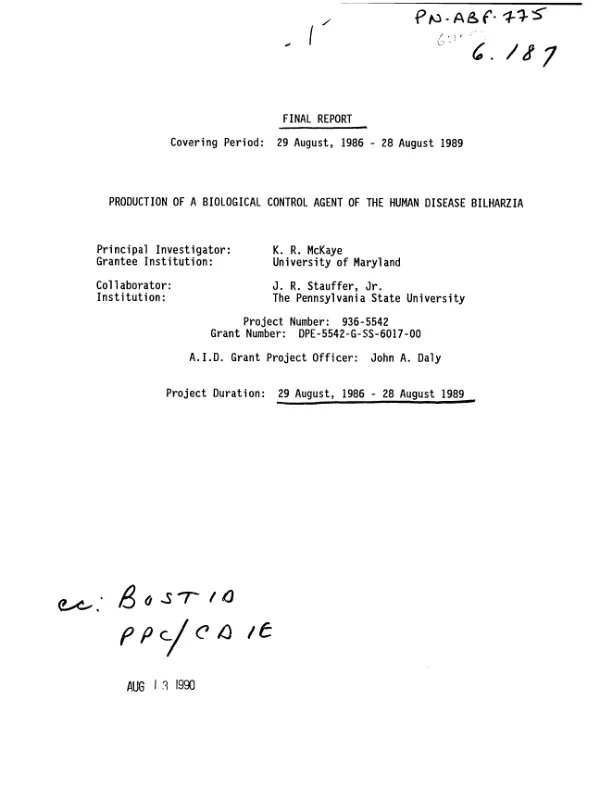
Final report, covering period : 29 August 1986-28 August 1989 -- production of a biological control agent of the human disease bilharzia
Open record 1988
1988USAID DEC