USAID DEC
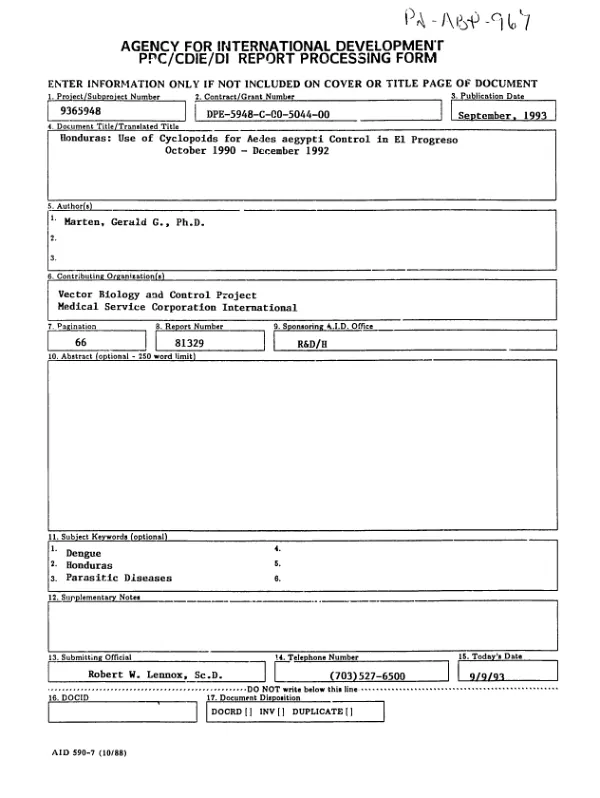
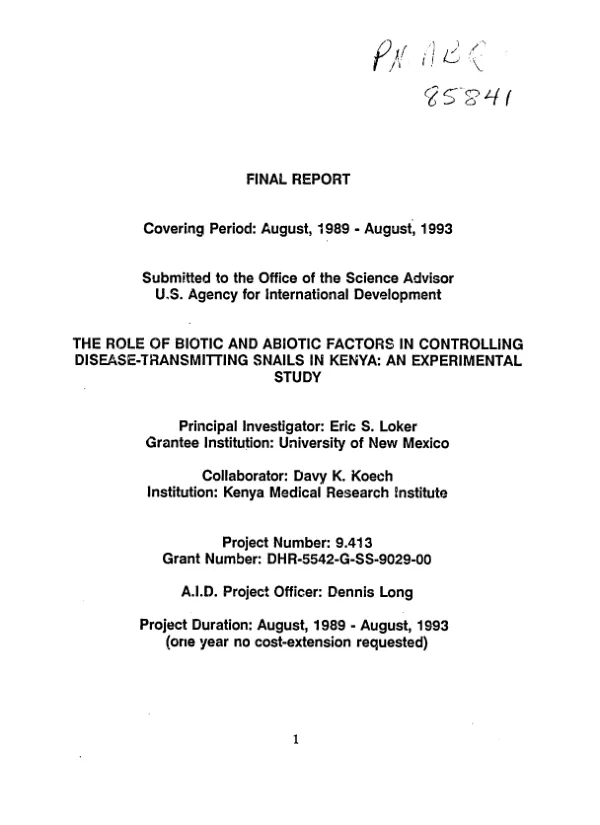
Final report : role of biotic and abiotic factors in controlling disease - transmitting snails in Kenya -- an experimental study
Sign inKENYA MEDICAL RESEARCH INSTITUTE
Final report : role of biotic and abiotic factors in controlling disease - transmitting snails in Kenya -- an experimental study
In sub-Saharan Africa, freshwater snails are transmitters of schistosomes and other trematode parasites.
Loker, Eric S.; Koech, Davy K. · 1970
Sign in to readA free account is required to download.
Abstract
The purpose of this study was to develop a biological method to control snail vectors. The study revealed that the North American red swamp crayfish Procambarus clarkii is a voracious predator of disease-transmitting pulmonate snails and can reduce or eliminate target snail populations in natural habitats in Kenya. P. clarkii, originally introduced into East Africa for aquaculture purposes, is now widely distributed in Kenya, and supports a small but thriving export industry centered at Lake Naivasha. The judicious use of crayfish in schistosomiasis control can provide a new weapon with which to control snails and break the cycle of disease transmission. However, because crayfish also attack non-target species, their use should be restricted to those human-made earthen dams -- which are ubiquitous in Kenya -- which function as transmission sites and do not harbor endangered biota. The study discusses the above issues in depth, as well as studies of other control agents such as competitor/predator snails, the development of a geographic information system to facilitate analysis of factors influencing snail distribution, and spin-off studies pertaining to snail systematics. (Author abstract)
Related documents
Documents in this collection
 2003
2003USAID DEC
Male circumcision : current epidemiological and field evidence -- program and policy implications for HIV prevention and reproductive health, September 18 and 19, 2002 : conference report
Open record 1970
1970USAID DEC
![Final report : towars [i.e. towards] an antigranuloma vaccine in Schistosomiasis mansoni -- molecular cloning and characterization of a putatively relevant antigen](https://covers.devme.ai/gen/42716.webp)