USAID DEC
Biome stability in South America over the last 30 kyr: Inferences from long-term vegetation dynamics and habitat modelling
Sign inUSAID DEC
Biome stability in South America over the last 30 kyr: Inferences from long-term vegetation dynamics and habitat modelling
South America's biomes have undergone significant changes over the last 30,000 years.
2018 · 2 pages
Sign in to readA free account is required to download.
Abstract
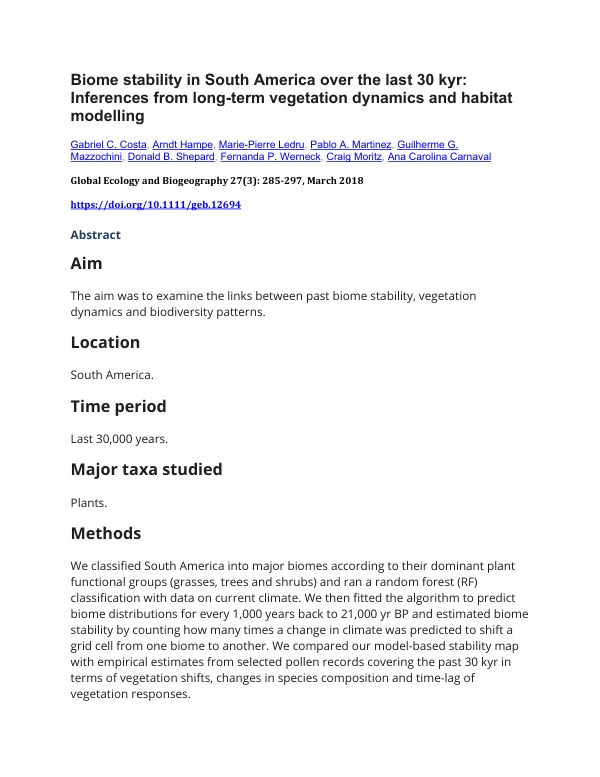
The continent's vegetation dynamics and habitat modeling have been used to infer the stability of these biomes. The study focused on the dominant plant types, including grasses, trees, and shrubs, and used a random forest classification to predict biome shifts every 1,000 years back to 21,000 years before present. The results showed a strong correlation between the predicted biome shifts and vegetation dynamics. The study identified four scenarios of forest distribution shifts during climate change, each associated with specific biome stability and diversity patterns. These scenarios provide a framework for understanding how taxonomic, genetic, and functional components of biodiversity may be impacted by climate change. The study's findings have important implications for understanding the effects of past climate on biodiversity in South America. The validated map of biome stability provides a baseline for studying the impacts of climate change on the continent's ecosystems. By focusing on climatic changes that result in significant habitat shifts, the study offers a novel perspective that complements previous datasets and allows for the exploration of new questions and hypotheses at local, regional, and continental scales. The study's results suggest that the stability of South America's biomes has been influenced by climate change over the last 30,000 years. The continent's vegetation dynamics and habitat modeling have been used to infer the stability of these biomes, providing a framework for understanding the impacts of climate change on biodiversity. The study's findings have important implications for conservation and management efforts in South America, highlighting the need to consider the long-term effects of climate change on the continent's ecosystems. The study's methodology involved classifying South America into major biomes based on dominant plant types and using a random forest classification to predict biome shifts every 1,000 years back to 21,000 years before present. The results showed a strong correlation between the predicted biome shifts and vegetation dynamics, providing a validated map of biome stability. The study's findings have important implications for understanding the effects of past climate on biodiversity in South America, highlighting the need to consider the long-term effects of climate change on the continent's ecosystems.