USAID DEC
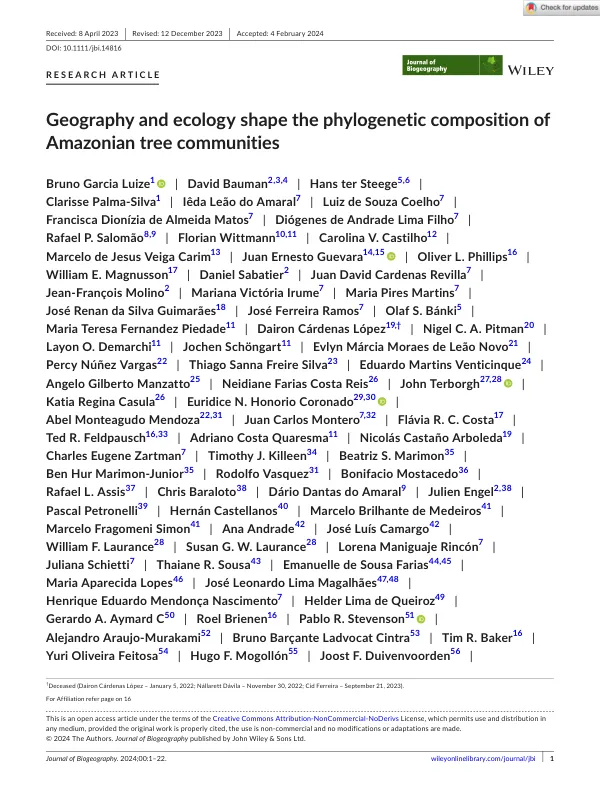
Geography and ecology shape the phylogenetic composition of Amazonian tree communities
Sign inUSAID DEC
Geography and ecology shape the phylogenetic composition of Amazonian tree communities
Amazonia hosts a vast array of tree species from various evolutionary lineages, both young and ancient.
2024 · 22 pages
Sign in to readA free account is required to download.
Abstract
Previous studies have shown that tree lineages colonized multiple edaphic environments and dispersed widely across Amazonia. This led to a hypothesis that lineages should not be strongly associated with either geographic regions or edaphic forest types. However, the results of this study contradict this hypothesis, revealing that numerous tree lineages, including some ancient ones, show strong associations with geographic regions and edaphic forest types of Amazonia. The study combined data from 1989 plots with a mega-phylogeny, applying evolutionary ordination to assess how phylogenetic composition varies across Amazonia. Variation partitioning and Moran's eigenvector maps (MEM) were used to test and quantify the separate and joint contributions of spatial and environmental variables to explain the phylogenetic composition of plots. The results show that soil chemistry, climate, and topography explain 24% of the variation in phylogenetic composition, with 79% of that variation being spatially structured. The phylogenetic composition also shows substantial spatial patterns not related to the environmental variables quantified, with an R2 value of 28%. A greater number of lineages were significant indicators of geographic regions than forest types. This suggests that specialization in specific edaphic environments has played a long-standing role in the evolutionary assembly of Amazonian forests. The study found that the phylogenetic composition varies by geographic region in the terra firme and várzea forest types, but the igapó and white-sand forest types retain a unique evolutionary signature regardless of region. This indicates that certain lineages have adapted to specific environmental conditions, leading to a diverse range of tree species in Amazonia. The results of this study have significant implications for our understanding of the evolutionary history of Amazonian forests. The findings suggest that the assembly of these forests has been shaped by a combination of environmental and spatial factors, leading to a unique and diverse array of tree species. This knowledge can inform conservation efforts and help to protect the biodiversity of Amazonia.
Related documents