USAID
BOLETINSEPTIEMBRE-Esp
The Colombian government has implemented significant regulations for the protection and conservation of its páramos over the past four years.
2018 · 1 pages
Sign in to readA free account is required to download.
Abstract
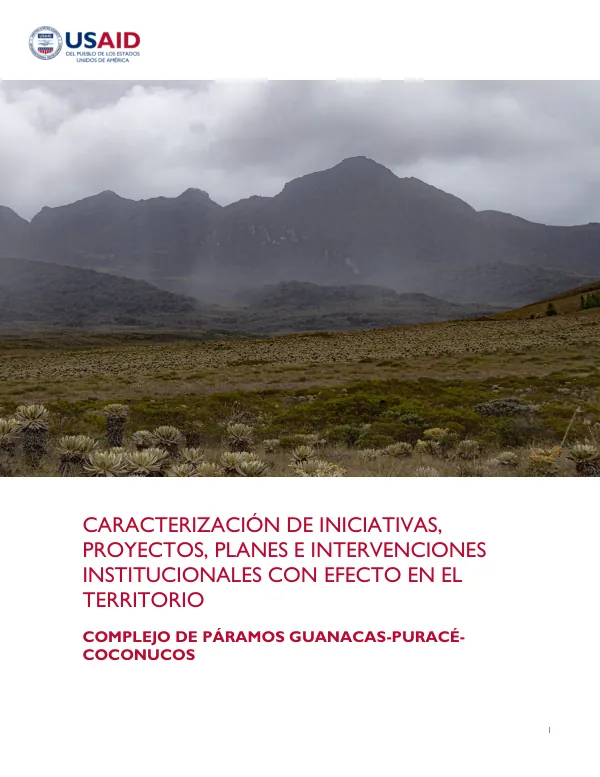
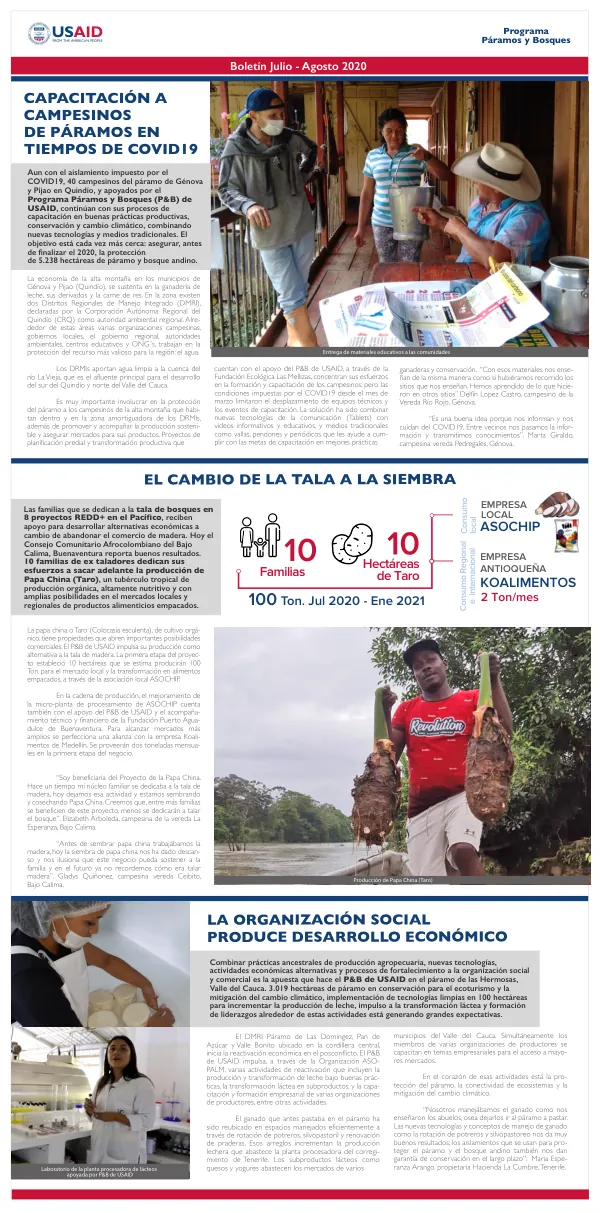
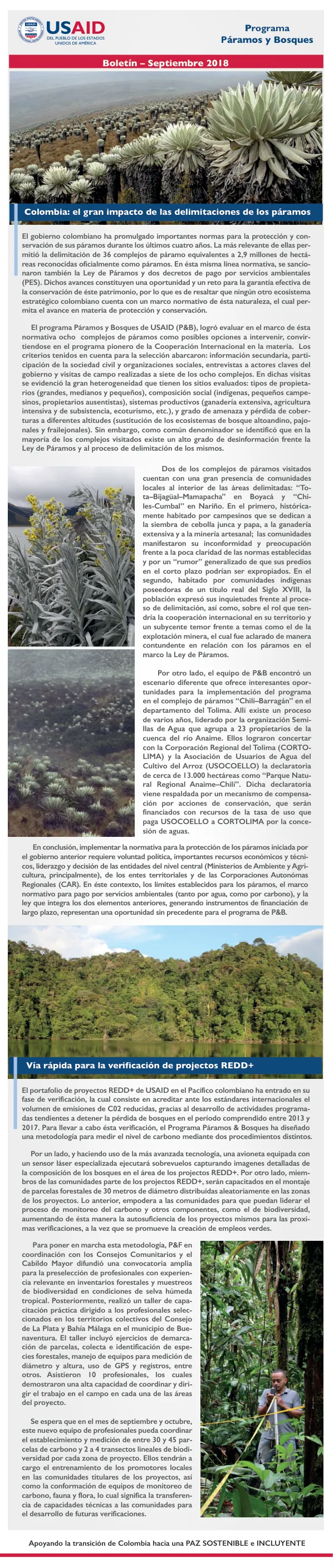
A key regulation allowed for the official recognition of 36 páramo complexes, equivalent to 2.9 million hectares, and sanctioned the Law of Páramos and two decrees on payment for environmental services (PES). These advancements present an opportunity and a challenge for the effective conservation of this patrimony, as no other strategic Colombian ecosystem has a similar regulatory framework. The USAID Páramos and Bosques (P&B) program evaluated eight páramo complexes as potential intervention options under this regulatory framework, becoming the pioneering international cooperation program in this area. The selection criteria included secondary information, participation of civil society and social organizations, interviews with key government actors, and field visits to seven of the eight complexes. These visits revealed the great heterogeneity of the evaluated sites, including types of owners (large, medium, and small), social composition (indigenous, small farmers, absentee owners), productive systems (extensive livestock, intensive agriculture, subsistence, ecotourism), and degree of threat and loss of cover at different altitudes. However, as a common denominator, it was identified that in most of the visited complexes, there is a high degree of misinformation about the Law of Páramos and the delimitation process. Two of the páramo complexes visited have a significant presence of local communities within the delimited areas: "Tota-Bijagüal-Mamapacha" in Boyacá and "Chiles-Cumbal" in Nariño. In the first, historically inhabited by farmers who cultivate onions and potatoes, raise livestock, and engage in artisanal mining, the communities expressed their discontent and concern about the lack of clarity in the established norms and a "rumor" about the possible expropriation of their properties in the short term. In the second, inhabited by indigenous communities with a title from the 18th century, the population expressed their concerns about the delimitation process, the role of international cooperation in their territory, and a latent fear about issues such as mining exploitation, which was clarified in relation to páramos under the Law of Páramos. On the other hand, the P&B team found a different scenario that offers interesting opportunities for the implementation of the program in the "Chilí-Barragán" páramo complex in the Tolima department. There is a process led by the organization Semillas de Agua, which groups 23 owners of the Anaime River basin, who have managed to concert with the Regional Corporation of Tolima (CORTOLIMA) and the Association of Water Users of the Rice Cultivation (USOCOELLO) the declaration of nearly 13,000 hectares as the "Anaime-Chilí Regional Natural Park". This declaration is supported by a compensation mechanism for conservation actions, financed with resources from the water use fee paid by USOCOELLO to CORTOLIMA. In conclusion, implementing the regulations for the protection of páramos initiated by the previous government requires political will, significant economic and technical resources, leadership, and decision-making by central government entities (Ministries of Environment and Agriculture, primarily), territorial entities, and Autonomous Regional Corporations (CARs). In this context, the established limits for páramos, the regulatory framework for payment for environmental services (both for water and carbon), and the law that integrates the two elements, generating long-term financing instruments, represent an unprecedented opportunity for the P&B program. The USAID REDD+ portfolio in the Colombian Pacific has entered its verification phase, which consists of accrediting international standards for the volume of CO2 emissions reduced, thanks to the development of programmed activities aimed at stopping forest loss between 2013 and 2017. To carry out this verification, the Páramos & Bosques program has designed a methodology to measure the level of carbon through two different procedures. On the one hand, using advanced technology, an airplane equipped with a specialized laser sensor will perform overflights capturing detailed images of the forest composition in the project areas. On the other hand, members of the communities participating in the projects will be trained in the installation of 30-meter diameter forest parcels distributed randomly in the project areas. This empowers communities to lead the carbon monitoring process and other components, such as biodiversity, increasing the autonomy of the projects for future verifications, while promoting the creation of green jobs. A rapid path for project REDD+ verification has been established. In coordination with the Community Councils and the Mayor's Council, P&B disseminated a broad call for the pre-selection of professionals with relevant experience in forest inventories and biodiversity sampling in tropical humid forest conditions. Subsequently, a practical training workshop was conducted for the selected professionals in the collective territories of the La Plata and Bahía Málaga Council in the municipality of Buenaventura. The workshop included exercises in parcel demarcation, species collection and identification,