USAID DEC
Boosting Girls' Confidence: Parents Team Up with Teachers to Provide Girls' Washrooms to Keep Girls in School
Sign inUSAID
Boosting Girls' Confidence: Parents Team Up with Teachers to Provide Girls' Washrooms to Keep Girls in School
Rwanda's efforts to expand access to education have yielded significant results, with enrollment increasing and repetition and dropout rates decreasing.
2 pages
Sign in to readA free account is required to download.
Abstract
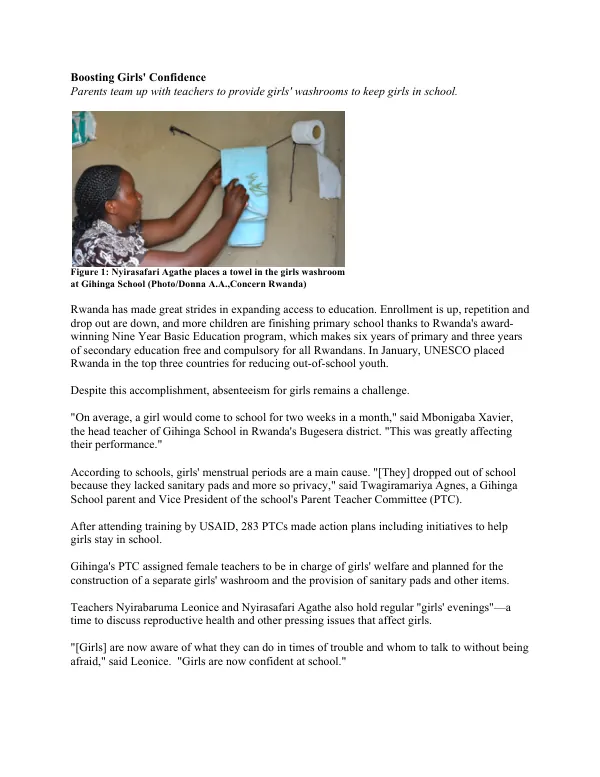
The country's Nine Year Basic Education program, which provides six years of primary and three years of secondary education free and compulsory for all Rwandans, has been instrumental in achieving this success. In January, UNESCO recognized Rwanda as one of the top three countries for reducing out-of-school youth. Despite these accomplishments, absenteeism among girls remains a challenge. According to school administrators, girls' menstrual periods are a primary cause of absenteeism, with many girls dropping out of school due to lack of sanitary pads and privacy. To address this issue, Parent Teacher Committees (PTCs) have been trained by USAID to develop action plans that support girls' education. At Gihinga School, the PTC assigned female teachers to oversee girls' welfare and constructed a separate girls' washroom, providing sanitary pads and other essential items. Teachers at Gihinga School have also implemented regular "girls' evenings," where they discuss reproductive health and other pressing issues affecting girls. These initiatives have led to increased confidence among girls, with one teacher noting that girls are now aware of what they can do in times of trouble and whom to talk to without fear. Similar efforts have been undertaken at Rugando Primary School, where parents constructed a washroom for girls and the school provided essential items such as sanitary pads, water, soap, basins, and towels. As a result of these initiatives, the number of girls regularly attending school has increased. The success of these efforts is expected to be replicated across the country as trainings for PTCs continue to roll out. The Literacy, Language, and Learning (L3) Initiative, a five-year program supported by USAID, is providing training and support to PTCs as part of its overall effort to improve early-grade literacy and numeracy skills of Rwandan children. The L3 consortium member Concern Worldwide Rwanda is playing a key role in training PTCs, equipping them with the skills and knowledge necessary to support girls' education. By addressing the challenges faced by girls in Rwanda, these initiatives aim to ensure that all children have access to quality education and the opportunities it provides.