USAID DEC
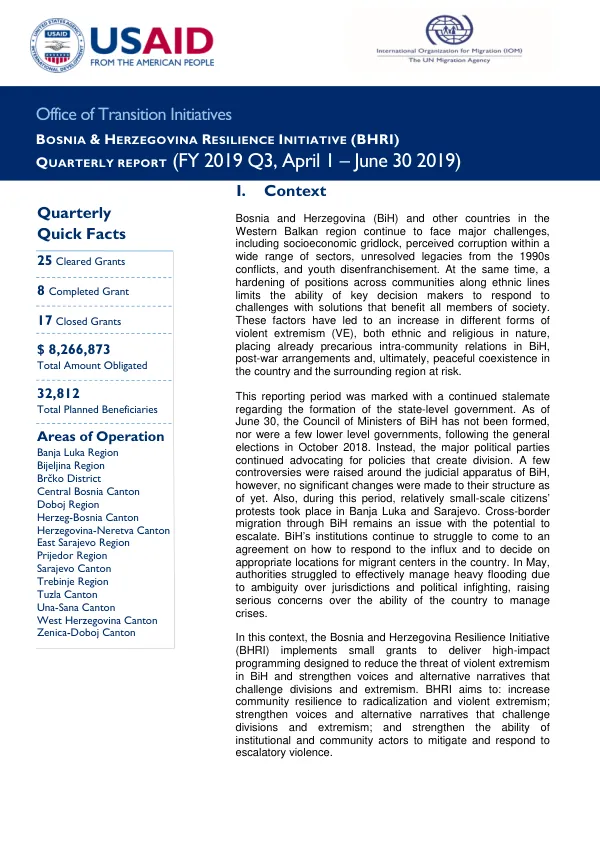
BOSNIA & HERZEGOVINA RESILIENCE INITIATIVE (BHRI) QUARTERLY REPORT (FY 2019 Q3, April 1 – June 30 2019)
Sign inUSAID
BOSNIA & HERZEGOVINA RESILIENCE INITIATIVE (BHRI) QUARTERLY REPORT (FY 2019 Q3, April 1 – June 30 2019)
Bosnia and Herzegovina Resilience Initiative (BHRI) implements small grants to deliver high-impact programming designed to reduce the threat of violent extremism in Bosnia and Herzegovina (BiH) and strengthen voices and alternative narratives that challenge divisions and extremism.
2019 · 3 pages
Sign in to readA free account is required to download.
Abstract
BHRI aims to increase community resilience to radicalization and violent extremism, strengthen voices and alternative narratives that challenge divisions and extremism, and strengthen the ability of institutional and community actors to mitigate and respond to escalatory violence. The BHRI operates in various regions of BiH, including Banja Luka, Bijeljina, Brčko District, Central Bosnia Canton, Doboj Region, Herzeg-Bosnia Canton, Herzegovina-Neretva Canton, East Sarajevo Region, Prijedor Region, Sarajevo Canton, Trebinje Region, Tuzla Canton, Una-Sana Canton, West Herzegovina Canton, and Zenica-Doboj Canton. The initiative focuses on promoting cultural heritage, social work, and youth engagement to prevent radicalization and violent extremism. One of the key projects implemented by BHRI is the "Set in Stone – Discovering BiH through Stećak" initiative, which aims to promote the cultural heritage of BiH through medieval tombstones known as stećci. The project engages young people from different communities to discuss their shared history and heritage, challenging divisive identity narratives that drive extremism in BiH. A web page dedicated to stećci has been created to promote the work of local teams across the country, and their Facebook page has over 1,300 followers. Another project, "Stepping Up Social Work to Prevent Radicalization in Bihać," aims to increase the capacities of the Center for Social Work (CSW) in Bihać to identify and prevent radicalization among young people. The CSW hired two additional staff members to work specifically on this issue, while BHRI engaged an international consultant to deliver trainings and guidance on how to work with and identify vulnerable youth. The "3D Youth Clubs - Dedicated, Determined and Driven Youth" project aims to increase youth resilience to radicalization and violent extremist influence in Zvornik and Kalesija, two neighboring municipalities in eastern BiH. BHRI supported a local NGO in establishing and running two youth clubs, providing space, equipment, and training to bolster their activism and run the youth clubs in their respective local areas. BHRI also organized a networking event for awardees working on similar issues, where they shared their experiences, exchanged ideas, and developed joint initiatives. The event resulted in several initiatives, including the creation of podcasts and joint web platforms, and BHRI-supported media outlets are working hard to strengthen voices and alternative narratives that challenge divisions and extremism on local or regional levels. An internal rolling assessment was held during the reporting period, which reviewed the program strategy, including previous and existing activities, to formulate conclusions about lessons learned, challenges, and successes. Regional Action Plans were updated to reflect local contextual analysis and better define program approaches moving forward. BHRI is also increasing its follow-on activities by building upon entry-level activities where the program identified effective partners and increased its understanding about community dynamics, VE issues, and effective programmatic approaches.
Related documents