INTEGRA GOVERNMENT SERVICES INTERNATIONAL, LLC
Broadband Stakeholder Mapping Framework
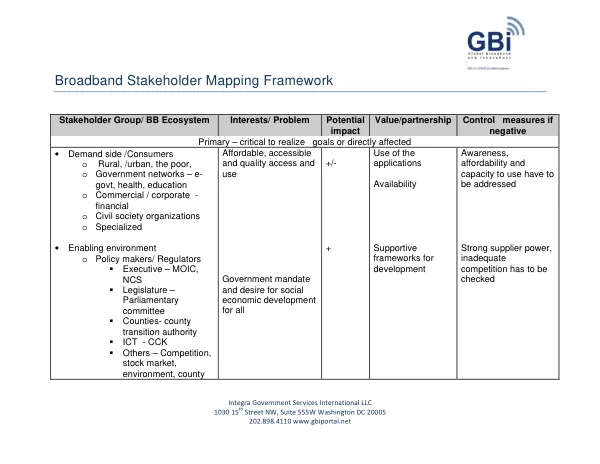
The Broadband Stakeholder Mapping Framework is a comprehensive framework that identifies and categorizes various stakeholders involved in the broadband ecosystem.
3 pages
Sign in to readA free account is required to download.
Abstract
The framework recognizes six primary stakeholders: consumers, government networks, commercial networks, civil society organizations, specialized organizations, and specialized stakeholders. Consumers are categorized into four subcategories: rural consumers, urban consumers, the poor, and corporate consumers. These consumers have diverse interests, including demand for broadband services, accessibility, and affordability. The framework highlights the importance of addressing awareness, capacity, and awareness among consumers to ensure effective broadband adoption. Government networks are comprised of executive, legislative, and regulatory bodies. These stakeholders have a critical role in creating an enabling environment for broadband development. They must balance their mandate for economic development with the need to address issues such as supplier power, inadequate competition, and inadequate competition. Commercial networks are categorized into three subcategories: operators, content developers, and equipment suppliers. These stakeholders have a significant impact on the broadband ecosystem, particularly in terms of infrastructure development, content creation, and equipment provision. The framework emphasizes the need to balance commercial interests with consumer interests to ensure sustainable broadband development. Civil society organizations and specialized stakeholders are also identified as key players in the broadband ecosystem. These stakeholders can influence broadband development through their advocacy and lobbying efforts. They can also contribute to the creation of value and justification for broadband development. The framework highlights the importance of synergistic partnerships between stakeholders to achieve universal broadband access. It emphasizes the need to explore alternative energy sources and explore alternative energy sources to power broadband infrastructure. The framework also recognizes the critical role of neighboring countries, media, and academia in shaping broadband development. The Broadband Stakeholder Mapping Framework provides a structured approach to understanding the complex relationships between stakeholders in the broadband ecosystem. It offers a framework for analyzing the interests, problems, and potential impact of various stakeholders and identifying opportunities for collaboration and coordination to achieve sustainable broadband development.