INTEGRA GOVERNMENT SERVICES INTERNATIONAL, LLC
Localization Engagement Assessment for Kenya and East Africa
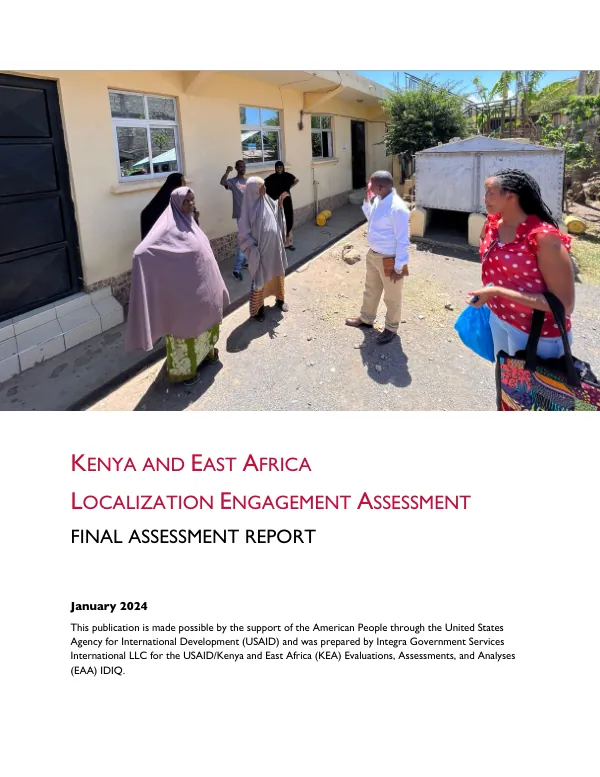
The Localization Engagement Assessment (LEA) was conducted to support USAID/Kenya and East Africa's (USAID/KEA) localization efforts through actionable recommendations based on learnings from its experiences to date.
2024 · 65 pages
Sign in to readA free account is required to download.
Abstract
The LEA used a phased approach to gather insights related to the Mission's experiences, which were framed by four assessment categories. The Assessment Team provided direct answers to all sub-questions, guiding recommendations developed and presented in line with each category. The Mission's achievement in increasing the number and level of funding for local awards to close to 50 percent of its portfolio is particularly noteworthy. This achievement is well ahead of the Agency-wide target for doing so by 2030. In doing so, the Mission accelerated a learning process that can be an Agency-wide model for what it has dubbed as Localization 2.0. Under Objective 1, covering the extent and success of the Mission's implementation of localization, the LEA found that the Mission has been highly successful in increasing the level of funding through local engagements. However, it now needs to direct more attention and resources toward developing shared-value partnerships. Local awards are not yet perceived by Mission staff as achieving the expected results, but there is evidence that the investment in local capacity strengthening is paying off, including by increasing collaboration with and among local actors and stakeholders. Investments in capacity strengthening, both pre-award and during implementation, can also support risk management as the Mission can be well positioned to identify potential risks through its early engagements with local partners. Although it is early in the process, and there is insufficient data to measure the sustainability of activity-level outcomes to date, improving relationships with and among local actors and stakeholders and the viability of the operational models of local partners, including through diversified funding streams, can be considered sentinels for sustaining outcomes from USAID activities. Under Objective 2, related to the Mission's processes and structures, the LEA found that there is a high level of appreciation for USAID's localization efforts to date, while related skills and processes for managing local engagements continue as areas for improvement. Local partners are calling for more collaboration, flexibility, capacity strengthening, and systems development milestones to be integrated into awards in support of their developing abilities to assume accountability for and ownership of results. There is a need for defining action for localization in Kenya, with clear objectives and measurable success metrics that can be supported by a shift to an investor mindset to maximize the intrinsic value and return on investment (ROI) in localization. The next implementation phase represents an operational and mindset shift for USAID/KEA and its partners and stakeholders, requiring change management. The Front Office can provide leadership, implementing coordinated and standardized relationship and portfolio management strategies with joint support and responsibility across technical and service line offices. The LEA provides forward-leaning recommendations to assist in this process, including relationship and portfolio management approaches and tools. To help guide this approach, the LEA suggests a need for defining action for localization in Kenya that aligns with the perspectives of local partners and stakeholders. Localization is the process of maximizing development impact by building shared-value partnerships with a range of local partners and investing in their capacity to sustain and scale results in line with USAID, local government, community, and private sector development priorities. This approach has five core objectives, supported by success metrics and tools to track progress: Objective 1: Optimize the ROI in localization; Objective 2: Maximize the intrinsic value of localization in sustaining results; Objective 3: Utilize a CLA approach to support portfolio management; Objective 4: Cultivate shared-value partnerships to mitigate risk and scale positive impact; and Objective 5: Forge joint initiatives at the county level for public-private collaboration toward shared development outcomes. This forward-leaning approach requires the Mission to take on an investor mindset to prioritize relationships over immediate results, focus investment in local capacity as much as programmatic activities, and utilize a CLA approach to support decision-making in portfolio management, based on a more nuanced understanding of impact and in a way that prioritizes progress and outcomes throughout the program cycle over activity-level results.
Related documents