USAID DEC
Building Resilient Communities in Stefan Voda Rayon Quarter 2 Report January 2024 – March 2024
Sign inUSAID
Building Resilient Communities in Stefan Voda Rayon Quarter 2 Report January 2024 – March 2024
The Building Resilient Communities in Ștefan Vodă Rayon program is a 1-year initiative implemented by Helvetas Swiss Intercooperation, with funding from USAID/BHA.
2024 · 18 pages
Sign in to readA free account is required to download.
Abstract
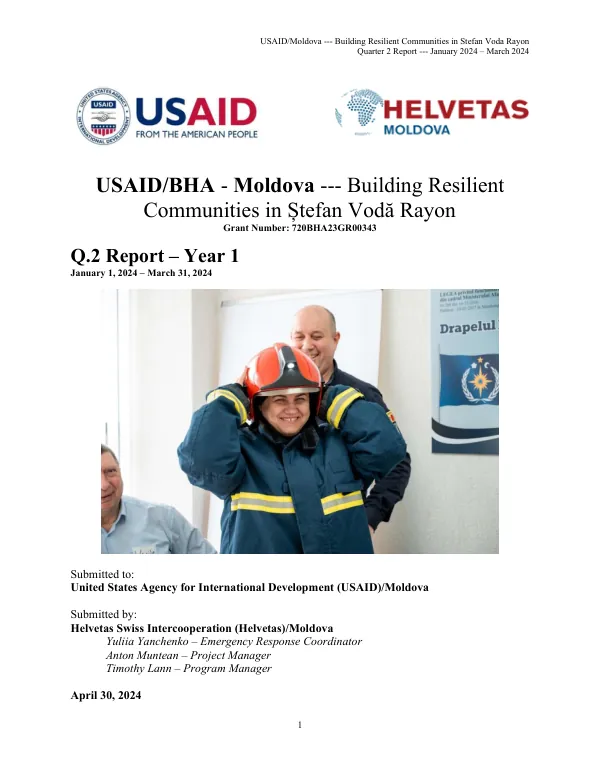
The program aims to increase community understanding and awareness of existing vulnerabilities and hazards, as well as develop multi-stakeholder disaster preparedness plans to increase community resilience to potential hazards. During the reporting period, January 1, 2024, to March 31, 2024, Helvetas continued the work on the program across both Outcomes, conducting several Community Management Committee (CMC) meetings and workshops, as well as developing draft versions of 4 Emergency Preparedness Plans. The draft plans have been discussed with key program stakeholders and final versions will be shared with USAID during Q3. The program has made significant progress towards Outcome 1 and Outcome 2 objectives. Outcome 1 focuses on improving community understanding of vulnerabilities, hazards, and vulnerabilities through inclusive community-led risk assessments and prioritization of actions. Outcome 2 aims to develop multi-stakeholder disaster preparedness plans and increase community resilience to potential hazards. During the reporting period, 4 CMC meetings were held in Stefan Voda, Răscăieți, Talmaza, and Palanca. The purpose of these meetings was for representatives of each stakeholder group to prioritize preparedness actions based on community-led assessments of hazards and risks. These sessions resulted in a multi-stakeholder consensus on priorities and identification of individual and communal measures to be taken to increase preparedness. In addition to the CMC meetings, several consultations were held with the Chief of the Regional GIES Department, Mr. Oleg Topor, with input provided for the elaboration of the workshop agendas. Workshops were conducted in a disaster response simulation environment, allowing participants to actively engage in exercises and provide feedback. Discussions focused on the prioritization of risks, as well as strategies for risk reduction and preparedness actions. Four workshops were conducted: Palanca on February 9, 2024, Răscăieți on February 15, 2024, Talmaza on February 16, 2024, and Stefan Voda on February 20, 2024. Each workshop hosted 12 participants, with representatives from all relevant stakeholders. Following the exercises, feedback was provided, which created the foundation for the initial development of the Emergency Preparedness Plans. Four Emergency Preparedness Plans have been developed, tailored to meet the specific needs and characteristics of the Ștefan Vodă Rayon. These plans delineate the responsibilities of various entities, detail actions for risk reduction, and describe preparedness strategies. They also highlight the necessity for awareness-raising campaigns and early warning systems to ensure the community is well-informed about the measures to mitigate hazards and reduce risks. The plans outline detailed activities, responsibilities, and expectations for each stakeholder group, including government stakeholders, educational institutions, community representatives, and the private sector. The plans are designed to ensure relevance and effectiveness in emergency management. The program has made significant progress in improving community understanding of vulnerabilities, hazards, and vulnerabilities through inclusive community-led risk assessments and prioritization of actions. The draft Emergency Preparedness Plans have been developed, and final versions will be shared with USAID during Q3. The program is on track to achieve its objectives and increase community resilience to potential hazards.