USAID DEC
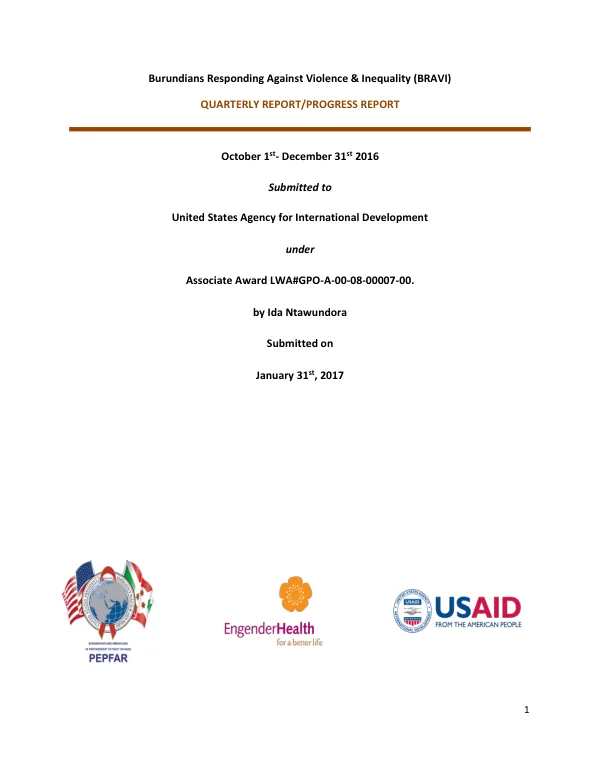
Burundians Responding Against Violence and Inequality (BRAVI) Quarterly Report/Progress Report
Sign inENGENDERHEALTH
Burundians Responding Against Violence and Inequality (BRAVI) Quarterly Report/Progress Report
The Burundians Responding Against Violence and Inequality (BRAVI) project is a five-year initiative aimed at improving sexual and gender-based violence (SGBV) prevention and response efforts in Burundi.
2016 · 23 pages
Sign in to readA free account is required to download.
Abstract
The project was awarded to EngenderHealth by the United States Agency for International Development (USAID) in September 2014. The project's objectives include strengthening the health sector response to SGBV, promoting awareness and use of SGBV services, and strengthening referral networks. During the reporting period, October 1st to December 31st, 2016, the project continued to make progress in achieving its objectives. One of the key activities undertaken during this period was the training of health providers in SGBV service provision. A total of 40 health professionals, including nurses, doctors, and supervisors, were trained in Ngozi Province. The training focused on gender and GBV basic concepts, SGBV screening, treatment based on national HIV standards, and referral services. The training methodology used by facilitators included presentations, brainstorming, role play, group work, and plenary sessions. Facilitators administered pre- and post-tests to measure participants' increased knowledge, shift in attitude, or behavior. The results showed a positive shift in knowledge level among participants, with 100% of participants scoring above the average in the post-test. However, two participants scored below average due to language barriers, as the questions were addressed in French, while the training was facilitated in two languages, French and Kirundi. The trained providers expressed their satisfaction with the training, citing their past experiences of providing SGBV services as a comparison. Many participants were moved by the activities included in the various sessions, and some had an emotional reaction at times. The project will organize post-training supervision in collaboration with the Ministry of Health to help trainees master SGBV services practices. In addition to the training of health providers, BRAVI has also trained them in SGBV data collection and reporting using a specific template. The results of the data collected for the period of October to December 2016 show a significant increase in the number of SGBV cases reported, with 46 cases reported in October, 25 cases in November, and 15 cases in December. The project's progress is a testament to the commitment of the health sector to addressing SGBV in Burundi. The training of health providers and the collection of SGBV data are crucial steps in improving the response to SGBV in the country. The project's continued efforts to strengthen the health sector response to SGBV will contribute to the reduction of SGBV cases and the improvement of the overall health and well-being of the population. The project's progress is also reflected in the increase in the number of SGBV cases reported. The results of the data collected for the period of October to December 2016 show a significant increase in the number of SGBV cases reported, with 46 cases reported in October, 25 cases in November, and 15 cases in December. This increase in reported cases is a positive trend, as it indicates that more survivors are seeking help and that the health sector is becoming more aware of the issue. The project's continued efforts to strengthen the health sector response to SGBV will contribute to the reduction of SGBV cases and the improvement of the overall health and well-being of the population. The project's achievements during the reporting period demonstrate its commitment to addressing SGBV in Burundi and its dedication to improving the health and well-being of the population.