USAID DEC
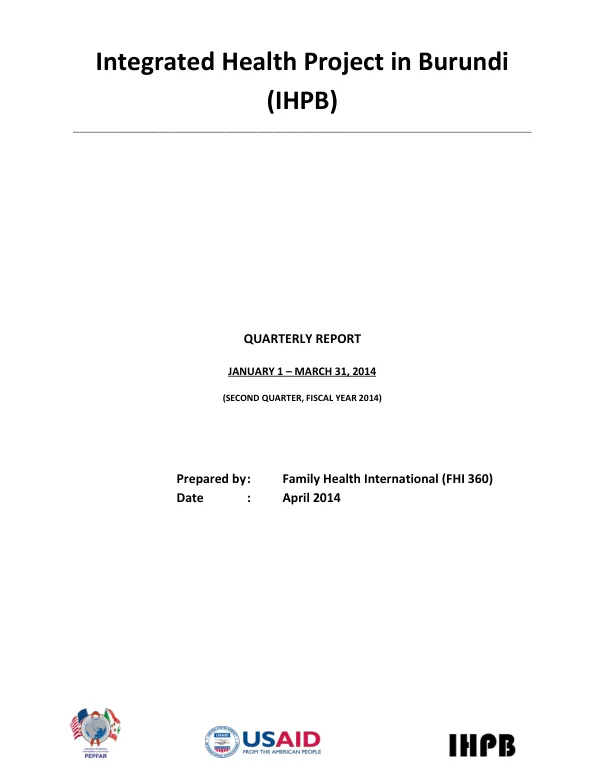
Quarterly Report: Integrated Health Project in Burundi (IHPB) - SECOND QUARTER, FISCAL YEAR 2014
Sign inABT ASSOCIATES
Quarterly Report: Integrated Health Project in Burundi (IHPB) - SECOND QUARTER, FISCAL YEAR 2014
The Integrated Health Project in Burundi (IHPB) is a five-year project funded by the United States Agency for International Development (USAID).
2014 · 7 pages
Sign in to readA free account is required to download.
Abstract
The project aims to improve the health status of assisted populations in 12 health districts located in the provinces of Kayanza, Muyinga, Kirundo, and Karusi. The IHPB builds on USAID's legacy of support to the health sector in Burundi and FHI 360 and Pathfinder's successes in assisting the Government of Burundi (GOB) to expand and integrate essential HIV/AIDS, maternal, neonatal, and child health (MNCH), and family planning (FP)/reproductive health (RH) services. The project's goal is to assist the GOB, communities, and civil society organizations (CSOs) to improve the health status of assisted populations. The expected results are: 1) increased positive behaviors at the individual and household levels; 2) increased use of quality integrated health and support services; and 3) strengthened health system and civil society capacity. The project will be implemented in two phases, with the first phase focusing on six health districts and the second phase expanding to four additional provinces. The IHPB will use a life stage approach to individual, household, and community health within C-Change's SBCC Framework. The project will also use "smart" integration supported by the Collaborative Model of service improvement and a health and community systems strengthening approach to ensure sustainable management. The integration and improvement activities will build on the experience from previous USAID-supported projects, such as ROADS II, BMCHP, and the Flexible Family Planning project. During the first year, the IHPB will implement activities that include continuing to support essential services supported under previous USAID-supported projects, conducting joint formative assessments with the Ministry of Public Health and the Fight against AIDS (MPHFA) in target districts, facilitating a participatory process to define initial integration and improvement ideas, and developing an integrated SBCC strategy. The project will also establish a QA/QI system and develop and support capacity strengthening plans for four CSOs. The IHPB has made significant progress in the first quarter of 2014. The project has completed recruitment and orientation of project staff, held a successful public launch of the IHPB, validated and submitted the Year 1 Work Plan, submitted a Life of Project (LOP) Performance Monitoring and Evaluation Plan (PMEP), and submitted a Branding Implementation and Marking Plan. The project has also finalized a Procurement Plan and begun the process for procuring goods and services. The IHPB has established partnerships with various stakeholders, including the Ministry of Public Health and the Fight against AIDS, the Swiss Cooperation Funded Project, National Health Programs, DELIVER Project, and URC. The project has also engaged with civil society organizations, including the Association Burundaise pour le Bien Etre Familial, Réseau Burundais des Personnes vivant avec le VIH, and the Society for Women Against AIDS. The IHPB will continue to work closely with the GOB, communities, and CSOs to improve the health status of assisted populations. The project will focus on implementing activities that promote positive behaviors, increase the use of quality integrated health and support services, and strengthen health system and civil society capacity. The project will also continue to monitor and evaluate its progress, using performance monitoring and evaluation to ensure effective implementation and achievement of results.