USAID. MISSION TO CAMEROON
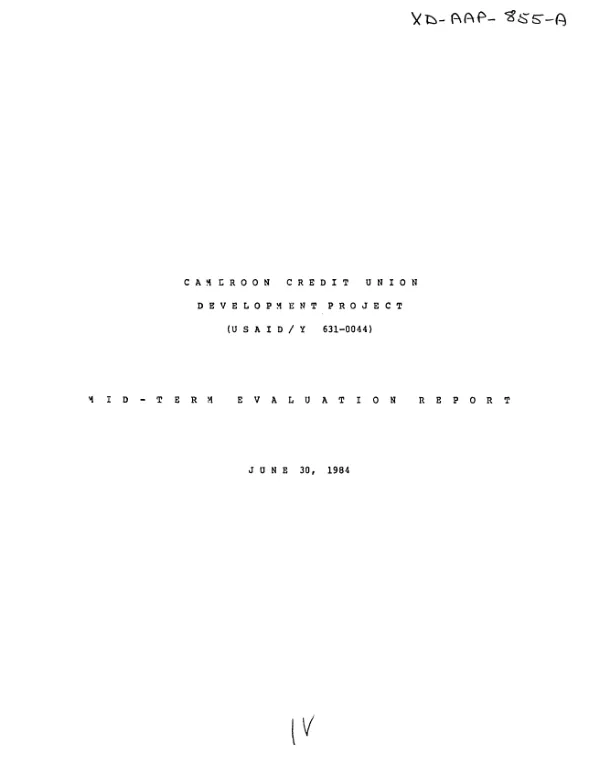
Cameroon credit union development project : mid-term evaluation report
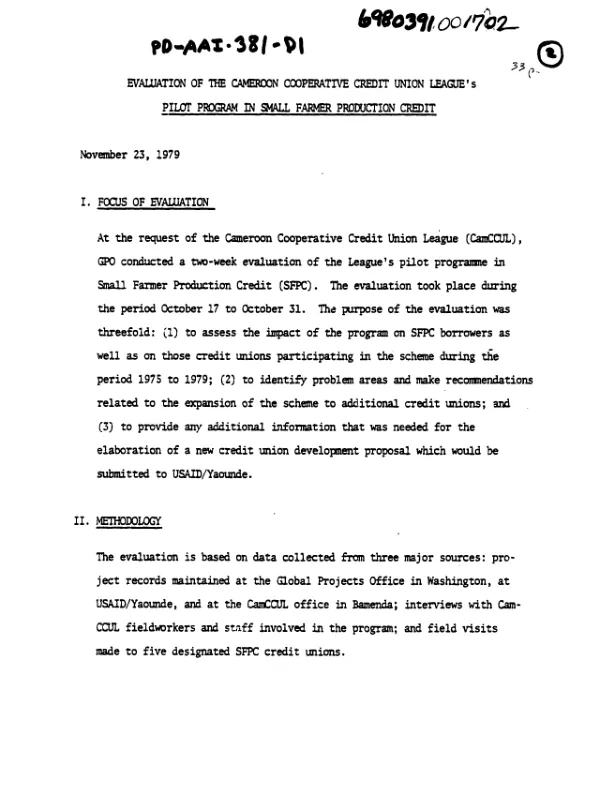
Evaluates project to strengthen the Cameroon Cooperative Credit Union League's (CCCUL's) financial and technical capabilities and to establish a pilot network of small farmer production credit unions (SFPCU's).
1984
Sign in to readA free account is required to download.
Abstract
Special evaluation covers the period 1981-6/84 and is based on document review, site visits, and interviews with project and credit union (CU) staff and with CU members. The project has been successful, due largely to the dedication of CU members who see the CCCUL as a private, voluntary, and social movement and to the fact that donor inputs are fully integrated into the existing CCCUL system. CCCUL/CU technical and financial skills have been upgraded through: 66 inservice seminars provided by CCCUL for 1,026 CU officers and 592 bookkeepers; on-the-job and formal courses for 59 CCCUL fieldworkers; and overseas and U.S. long- and short-term training for 8 CCCUL officials. Also, the project has conducted a training needs assessment and distributed educational materials to member CU's. Further efforts to strengthen CCCUL have included: developing 10 of 15 planned job descriptions and an employee performance appraisal system; producing accounting and auditing procedure manuals; initiating work on a 5-year plan; liquidating 11 nonviable CU's and merging 11 others into 5 stronger CU's; and opening a dialogue between CCCUL and Cameroon's other major CU association to plan their eventual merger. The SFPCU component has established 15 of 28 planned CU's, trained 45 officers and 9 fieldworkers, and resulted in an 85% increase in the average value of agricultural loans and a savings growth in SFPCU's 16% higher than in rural non-pilot CU's. Its production impact, however, has been less than expected. Capital shortages have proven to be less of a production constraint than have a lack of technical knowledge, input supply, markets, suitable prices for farm outputs, etc. Although to reach full financial viability by the project's end (currently CCCUL is 97.4% self-sufficient), CCCUL may not be able to hire needed staff or to offer member CU's attractive interest rates, it is concluded that achieving 100% viability would greatly benefit CCCUL's institutional credibility and should be attempted. Twenty-two recommendations are included.