USAID DEC
Can economic and environmental benefits associated with agricultural intensification be sustained at high population densities? A farm level empirical analysis
Sign inELSEVIER LTD.
Can economic and environmental benefits associated with agricultural intensification be sustained at high population densities? A farm level empirical analysis
Agricultural intensification in densely populated areas of sub-Saharan Africa is a critical issue due to its impact on crop production through land availability and quality.
2019 · 11 pages
Sign in to readA free account is required to download.
Abstract
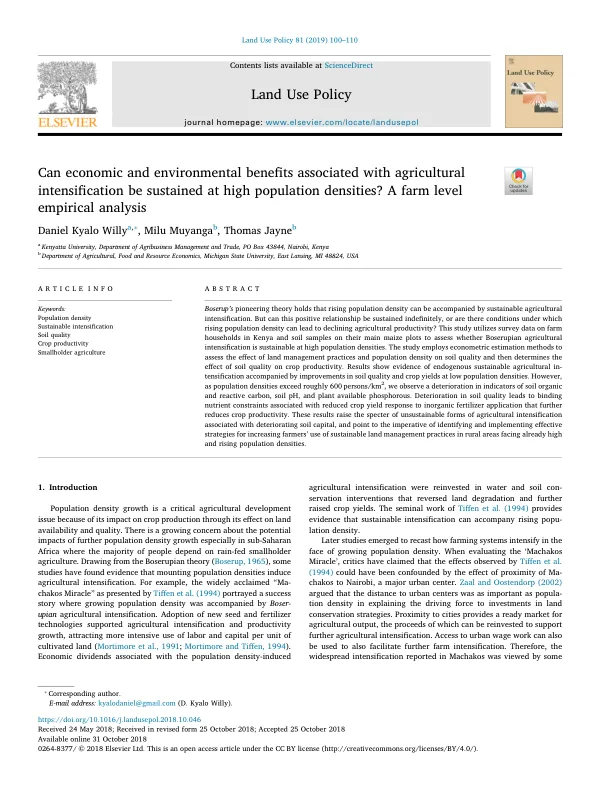
The Boserupian theory suggests that rising population density can be accompanied by sustainable agricultural intensification. However, the relationship between population density and agricultural productivity is complex, and the effects of population density on soil quality and crop yields are not well understood. Studies have shown that agricultural intensification can be achieved through the adoption of new seed and fertilizer technologies, which can lead to increased crop yields and improved livelihoods. However, the success of agricultural intensification is often dependent on factors such as proximity to urban centers, institutional and policy factors, and the availability of resources. For example, the "Machakos Miracle" in Kenya, which was documented in the 1990s, showed a positive relationship between population density and agricultural productivity. However, more recent studies have raised concerns that the productivity gains associated with agricultural intensification may be slowing down, particularly in areas with high population densities. The current study aims to evaluate the trends in agricultural intensification in the context of growing population densities in Kenya. The study was conducted in Machakos and Kisii Counties, which have different population densities and agro-ecological potential. The study used a cross-sectional survey among 290 randomly selected farm households to collect data on land management practices, plot attributes, and institutional factors. The study also collected plot-level soil sample data to assess the link between population density and agricultural productivity. The results of the study show that there is evidence of endogenous sustainable agricultural intensification accompanied by improvements in soil quality and crop yields at low population densities. However, as population densities exceed roughly 600 persons/km2, the study observes a deterioration in indicators of soil organic and reactive carbon, soil pH, and plant available phosphorous. This deterioration in soil quality leads to binding nutrient constraints associated with reduced crop yield response to inorganic fertilizer application, which further reduces crop productivity. The study's findings raise concerns about the sustainability of agricultural intensification in densely populated areas of sub-Saharan Africa. The results suggest that the positive relationship between population density and agricultural productivity may not be sustained indefinitely, and that there may be population density thresholds beyond which agricultural productivity declines. The study's contribution to the literature is three-fold: it tests the "more people less erosion" hypothesis using plot-level data, assesses the influence of agricultural intensification on soil quality and crop yields while controlling for urban influence, institutional, and policy factors, and combines socioeconomic data and plot-level soil quality data to evaluate the link between population density and agricultural productivity. The study's findings have implications for agricultural development policies and strategies in sub-Saharan Africa. They suggest that agricultural intensification may not be sustainable in densely populated areas, and that there may be a need to identify and implement effective strategies for increasing farmers' use of sustainable land management practices. The study's results also highlight the importance of considering the impact of population density on soil quality and crop yields when designing agricultural development programs.
Related documents
Documents in this collection
 2023
2023USAID DEC
Clinic presentation delay and tuberculosis treatment outcomes in the Lake Victoria region of East Africa: A multi-site prospective cohort study
Open record 2015
2015USAID DEC