USAID DEC
Quantifying increased groundwater demand from prolonged drought in the East African Rift Valley
Sign inELSEVIER LTD.
Quantifying increased groundwater demand from prolonged drought in the East African Rift Valley
Access to freshwater is a significant challenge globally, exacerbated by the changing climate.
2019 · 8 pages
Sign in to readA free account is required to download.
Abstract
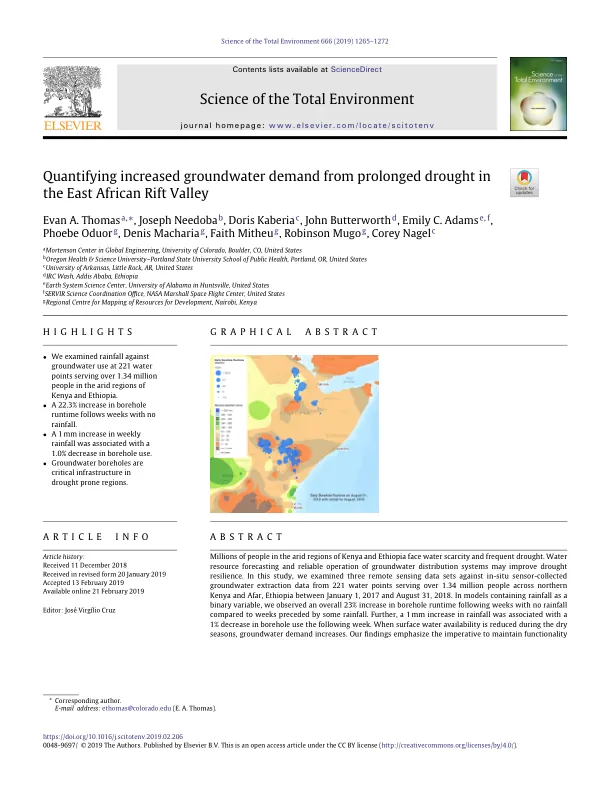
By 2025, 1.8 billion people will be living in countries or regions with absolute water scarcity, and two-thirds of the world's population could be living under water-stressed conditions, 80% of whom live in developing countries. Millions of people in the arid regions of the East African Rift Valley, including parts of Ethiopia and Kenya, are facing a significant threat from a lack of safe, reliable, and affordable water. The region has experienced increasing frequency and severity of drought conditions as a result of decreased rainfall during the long rainy season from March through May. Drought is expected to increase in severity and frequency over the coming years. The 2011 drought in East Africa caused food shortages for over ten million people and over 260,000 deaths. The more recent 2016 drought in Kenya resulted in over 3 million people facing food insecurity. These recent drought conditions represent an acute threat, highlighting the urgency of environmental changes driving water shortage and creating a public health and security emergency. Average rainfall in East Africa has been declining over the past several decades. In parts of this region, average rainfall has decreased over 20% since 1990. This trend in rainfall is in stark contrast to global climate model predictions of an increase in regional rainfall caused by climate change, a conundrum known as the East Africa Climate Paradox. The reason for the discrepancies between climate models and observed conditions are not precisely known, but are likely related to global and regional inconsistencies in ocean-atmosphere forcing by GCMs as well as to short-term environmental variability not captured by the models. In the arid regions of Kenya and Ethiopia, people are predominantly farmers and pastoralists reliant on reliable water sources for agricultural, livestock, and human uses. A mix of surface and groundwater use is common. Surface water use, including streams, rivers, lakes, and other rain-filled depressions and ponds, is regular practice during the rainy seasons when surface water is readily available. Prolonged drought is especially severe for smallholder farmers and pastoralists reliant on surface water sources including streams, rivers, and lakes. A majority of farmers in Kenya report perceiving climate change impacts on agricultural yields and have adopted some adaptation strategies, including changing crop varieties, planting dates, and crop types.