USAID DEC
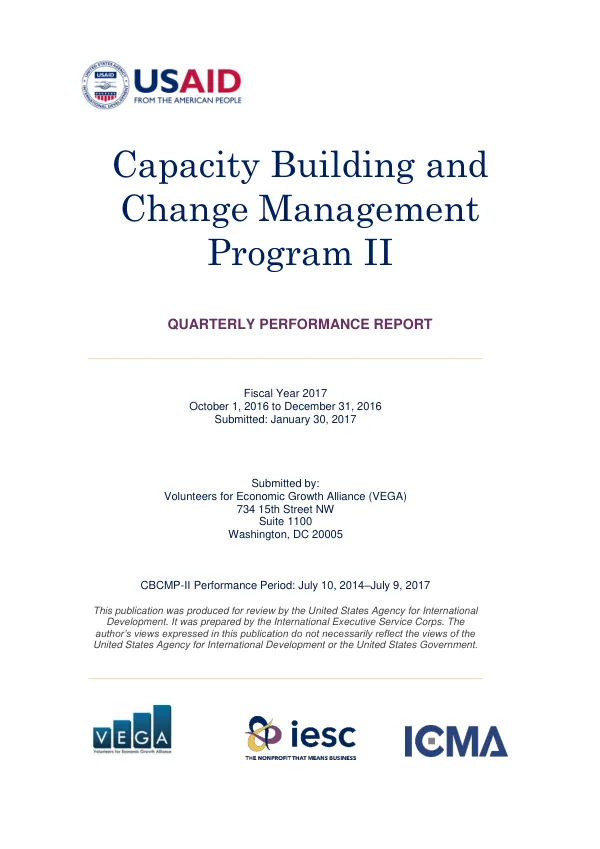
Capacity Building and Change Management Program II (CBCMP-II) Quarterly Report, October 1 – December 30, 2016, FY 2017
Sign inTHE INTERNATIONAL EXECUTIVE SERVICE CORPS
Capacity Building and Change Management Program II (CBCMP-II) Quarterly Report, October 1 – December 30, 2016, FY 2017
The Capacity Building and Change Management Program-II (CBCMP-II) is strengthening the human and institutional capacity of Afghanistan's Ministry of Agriculture, Irrigation, and Livestock (MAIL).
2017 · 71 pages
Sign in to readA free account is required to download.
Abstract
The program reinforces the linkages between MAIL and the Provincial Agriculture, Irrigation, and Livestock offices (PAILs). The program provides support to the PAILs, which enables these offices to effectively deliver agricultural services to farmers and herders. The program provides technical services to administrative and technical directorates within the ministry headquarters, 20 PAILs, and 50 District Agriculture, Irrigation and Livestock offices (DAILs) in Afghanistan's agricultural regions. The program commenced on July 09, 2014, and is implemented under the Volunteers for Economic Growth Alliance Leader with Associate Award mechanism by the International Executive Service Corps and the International City/County Management Association. The program builds on the USDA-funded CBCMP-I activity that ended on June 30, 2014. With the National Unity Government inaugurated in the fall of 2014, President Ashraf Ghani outlined his broad vision for realizing self-reliance through joint efforts with donors to increase Afghan-led development. CBCMP-II directly addresses President Ghani's concern through the use of the change management model of technical assistance, embedding Afghani change management specialists (CMS) within MAIL and PAILs to provide coaching, mentoring, and on-the-job training to civil service counterparts. The program interventions have strengthened linkages among MAIL, PAILS, and DAILs to ensure knowledge transfer is institution-wide and activities are coordinated at regional levels to benefit the ultimate beneficiaries – farmers and herders. The program has also automated procurement, human resources, inventory, and financial management systems, which are now under the process of expanding to the PAILs. Sustainability is enhanced by ensuring that civil servants have computer skills and internet access to utilize and manage these systems. The program has achieved several key accomplishments, including increasing the human resource capacity of civil servants in MAIL, PAILs, and DAILs. The program has also established and implemented relevant Ernst & Young (EY) and Office of Financial Management recommendations. Additionally, the program has strengthened the institutional capacity of target PAILs and DAILs, and has institutionalized the scaling of research and extension activities. The program has also reviewed and improved the system of monitoring extension workers. The program has also made significant progress in implementing its objectives, including supporting functions in MAIL directorates of finance and administration, monitoring and evaluation, procurement and contracts, and administration and human resources. The program has also strengthened the capacity of MAIL to prioritize, plan, budget, and secure approval/resources to support extension services by PAILs and DAILs. Furthermore, the program has increased the capacity of MAIL to carry out extension, research, and irrigation services in conjunction with the Afghanistan Agricultural Extension Project-II (AAEP-II). The program has also made significant progress in its gender mainstreaming efforts, with a focus on increasing the participation of women in agricultural development. The program has also implemented a coordination strategy to improve agricultural production and productivity and regenerate Afghan agricultural businesses. The program has also provided support to MAIL in its transition to the World Bank-funded Capacity Building for Results Program. The program has a strong technical leadership team, including a Chief of Party, Director of Institutional Capacity Building, Director of Public Finance Management, Director of Monitoring and Evaluation, Director of Communications, Director Gender, and Director Finance, Administration, and Compliance. The program has also established a robust monitoring and evaluation system to track its progress and ensure that it is meeting its objectives.