USAID DEC
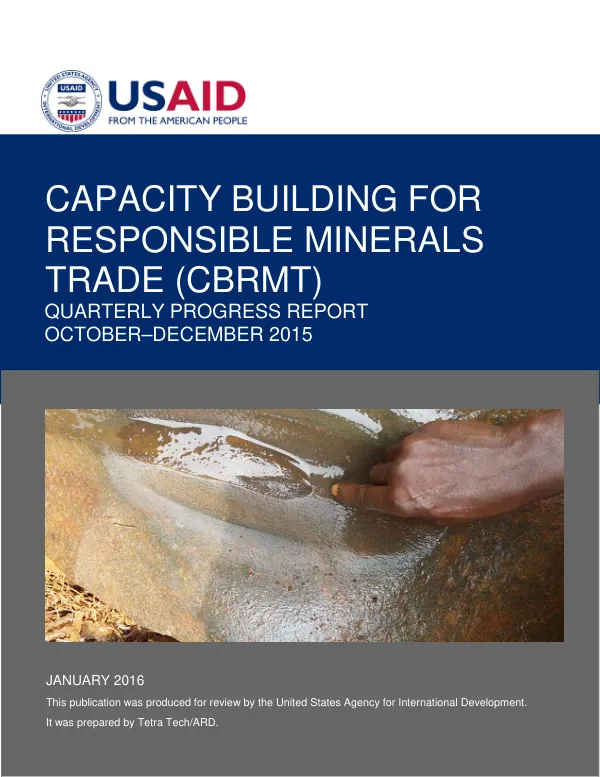
Capacity Building for Responsible Minerals Trade (CBRMT) Quarterly Progress Report October–December 2015
Sign inTETRA TECH
Capacity Building for Responsible Minerals Trade (CBRMT) Quarterly Progress Report October–December 2015
The Capacity Building for Responsible Minerals Trade (CBRMT) project supports the Government of the Democratic Republic of the Congo (GDRC) and the International Conference of the Great Lakes Region (ICGLR) to establish and scale up a responsible minerals trade from the region.
2015 · 31 pages
Sign in to readA free account is required to download.
Abstract
The project aims to transform the region's mineral wealth into economic growth and development. CBRMT has two program objectives: to increase the scale and quality of the conflict-free minerals supply chain, and to support the operationalization of the ICGLR. The project focuses on improving the legal and policy framework, strengthening the capacity of key actors, scaling up traceability and due diligence schemes, and strengthening ICGLR capacity. Technical assistance is provided to policymakers and other actors to improve the qualification missions in Maniema and Province Orientale. Technical assistance and training are also provided to supply chain actors, including due diligence, land tenure, and conflict resolution. Scaling up traceability and due diligence schemes is a key component of the project. In the tin, tungsten, and tantalum (3Ts) sector, the project is working in Numbi, Mwenga, and Lutunkulu to implement traceability and due diligence schemes. In the gold sector, the project is working in Matete and Mongbwalu-Ituri to implement similar schemes. The project is also working to operationalize the Regional Certification Mechanism and to strengthen ICGLR capacity. The project has made significant progress in the past quarter. Technical assistance has been provided to policymakers and supply chain actors, and due diligence and traceability schemes have been implemented in several areas. The project has also made progress in strengthening ICGLR capacity, including the implementation of the Independent Mineral Chain Auditor (IMCA) and the training of third-party auditors. The project has also made progress in cross-cutting activities, including gender and monitoring and evaluation. The project has established a gender working group to promote gender equality and women's empowerment in the mining sector. The project has also established a monitoring and evaluation system to track progress and identify areas for improvement. Overall, the CBRMT project is making significant progress in its efforts to establish and scale up a responsible minerals trade from the region. The project's focus on improving the legal and policy framework, strengthening the capacity of key actors, and scaling up traceability and due diligence schemes is critical to achieving its objectives. The project's progress is reflected in the following key indicators: * 27% increase in the number of conflict-free mine sites validated * 60% increase in the number of supply chain actors trained in due diligence and traceability * 50% increase in the number of third-party auditors trained * 30% increase in the number of women participating in the project's gender working group The project's success will depend on continued support from the GDRC, ICGLR, and other stakeholders. The project will continue to work to strengthen the capacity of key actors, scale up traceability and due diligence schemes, and operationalize the Regional Certification Mechanism. The project's next steps will include: * Continuing to provide technical assistance to policymakers and supply chain actors * Scaling up due diligence and traceability schemes in the 3Ts and gold sectors * Operationalizing the Regional Certification Mechanism * Strengthening ICGLR capacity, including the implementation of the IMCA and training of third-party auditors * Continuing to promote gender equality and women's empowerment in the mining sector