USAID DEC
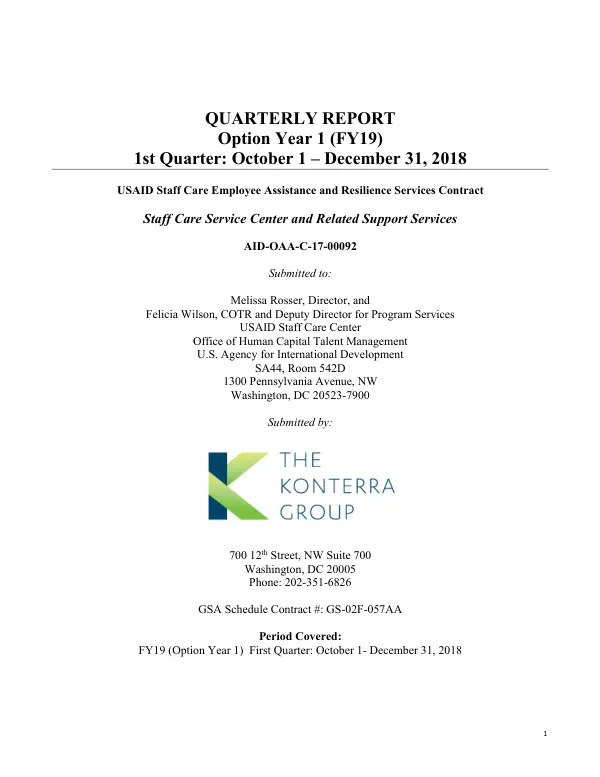
Quarterly Report: USAID Staff Care Employee Assistance and Resilience Services Contract FY19-Q1
Sign inUSAID
Quarterly Report: USAID Staff Care Employee Assistance and Resilience Services Contract FY19-Q1
The Staff Care Services Center (SCSC) served USAID individuals over 6,970 times during the first quarter of FY19, including awareness raising and resources for 3,598 individuals through the Staff Care Scoop, Staff Care overviews for employees and visibility events in the US and one Mission, and through SCSC visits and website.
2019 · 19 pages
Sign in to readA free account is required to download.
Abstract
SCSC provided resilience capacity building for 82 individuals, including pre-deployment and other workshops for 45 staff in three Missions and one Washington team, and capacity building and consultations for 37 managers. SCSC also provided counseling for 123 individuals/couples, critical incident support for 130 staff and family members following the death of a colleague, wellness education and activities for 2,027 individuals, and work-life services for 252 individuals. These services were designed to address stress, low moods, anxiety/panic, workplace conflict, grief, legal and financial issues, dependent care, health and wellness, work and life effectiveness, and emergency backup care. SCSC served 664 staff in 12 Missions (9 TDYs, 1 virtual), providing individual/group counseling, critical incident response, organizational resilience team engagements, resilience workshops and work-life and wellness activities as needed. SCSC also served 94 staff in 7 Washington teams through retreats and consultations to build organizational resilience and team cohesion. The SCSC services resulted in 840 work days saved, valued at $323,075, and helped improve individual and team performance, stress, resilience, wellbeing, job satisfaction, morale and commitment to USAID. Comparison of pre and post assessments of counseling clients showed a 6% overall improvement in wellbeing. The Front Page Agency Newsletter in November highlighted OPM's selection of USAID Staff Care as a best practice for 2018 and Bob Leavitt, HCTM, highlighted Staff Care's accomplishments in his Happy Thanksgiving email to HCTM staff. The top 5 concerns for counseling clients were personal stress, workplace stress, low/fluctuating mood, anxiety/panic, and conflict at work. The primary reasons for emergency backup care were travel/TDY, regular care unavailable, school closure, and other reasons. The key themes for team engagements were improving team cohesion, communication and trust, managing stress, change and uncertainty, and strengthening leadership and management capacity. The USAID Missions supported in FY19-Q1 included Afghanistan, Armenia, DRC, El Salvador, Georgia, Ghana and West Africa Mission, Guinea and Sierra Leone, Middle East Regional Platform/RFMO, Nicaragua, Nigeria, Regional Syria Platform/Turkey, Pakistan, Vietnam, and Zimbabwe. The USAID Washington Teams supported in FY19-Q1 included DCHA/OFDA, GH, HCTM/FEI Leadership Program, HCTM/XOSR, LPA/Leadership, OAPA & Asia Bureau, OAPA/AMS, PPL/LER/Monitoring, SEC/ISS, and T3. The key outcomes of the SCSC services included kudos from OPM, which recognized USAID's Staff Care as the most-used Employee Assistance Program in the Federal Government. Participants completed evaluation surveys at the close of their participation in Staff Care services, reporting actual or expected improvements in individual and team wellbeing and performance, as well as improved job satisfaction, morale and commitment to USAID. The estimated value of saved work days was $323,075, and the estimated savings based on $100,000 salary was 840 work days.
Related documents