USAID. MISSION TO GUATEMALA
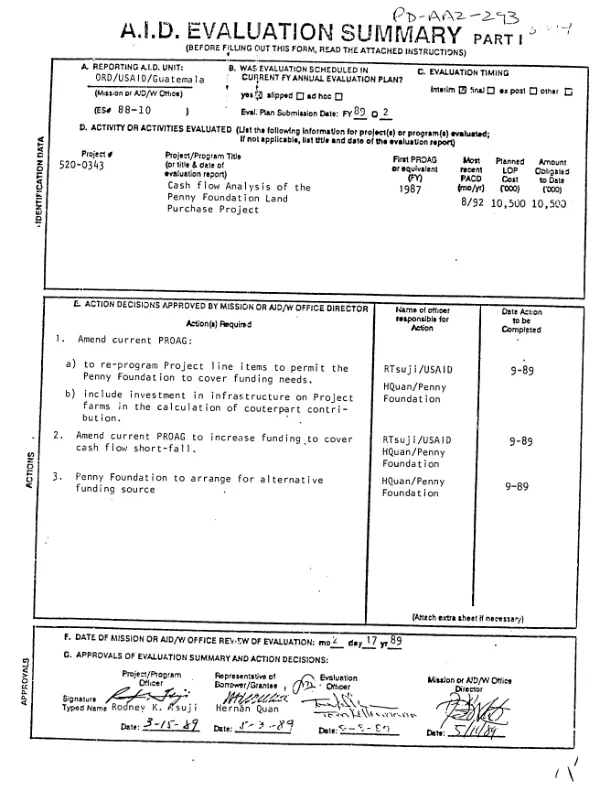
Cash flow analysis of the Penny Foundation land purchase project
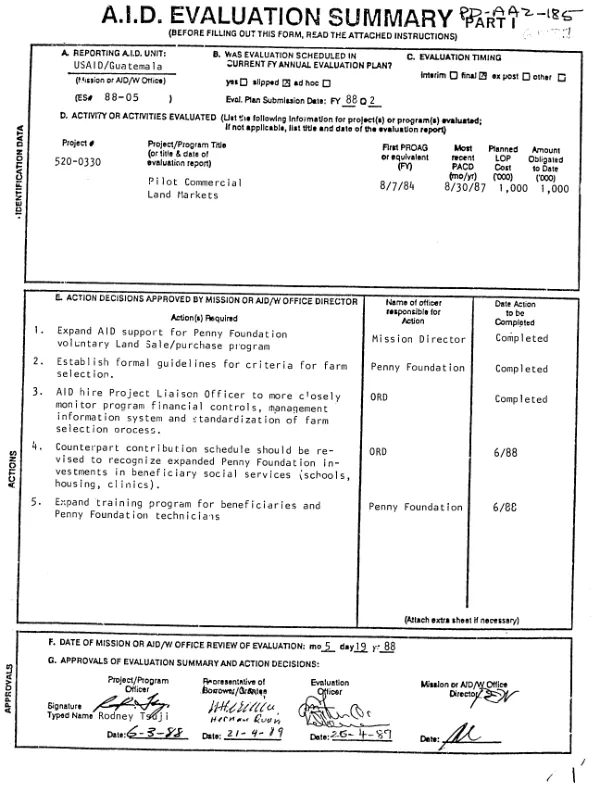
Summarizes attached interim evaluation of a pilot project, implemented by Fundacion Centavo (Penny Foundation or PF) to establish a mechanism to help small farmers in Guatemala to purchase land.
1989
Sign in to readA free account is required to download.
Abstract
The evaluation covered the period through 8/88 and focused on the project"s cash flow situation. The evaluation team used actual financial information for the years 1985-1987 and projected forward to 1996 using assumptions and suppositions derived from current economic trends and from PF"s implementation plan. The major findings and conclusions are: (1) PF accelerated its purchase of land, causing pressure on the production credit needs and certificate repayment aspects of the project. (2) A change in crop mix caused a radical change in cash flow timing. (3) The project is extremely sensitive to the timing of land purchases, and the resulting rate of crop integration. (4) Because PF was allowed to request A.I.D. funds on the basis of total costs rather than net costs after re-flows, it was not obligated to re-invest reflows back into the Project, thus getting the project into deeper and deeper trouble as the land purchases required more production credit and certificate payment. Furthermore, this method of funding allows PF to continue to purchase land even when in a precarious cash flow position. (5) The PF has been changed into a land bank/production credit bank which makes it necessary that it understand that its role has changed and as a result requires a new strategic attitude toward this Project. Major recommendations: (1) A.I.D. must change how PF requests funds. Making requests on a net cost basis will force PF to be responsible for making the project a self-sufficient entity. Without such responsibility, it can simply continue to purchase more land without planning for the consequences. The inflows must be reinvested in the project to meet current obligations and not simply used to purchase more land. (2) A careful evaluation of how PF formulates its planning for this project must be made. PF is now a financial intermediary and must plan for the long term rather than short term. (3) As far as solving the cash shortfall problem, probably the best alternative is to allow A.I.D. funds to be used to repay guaranty certificates. (4) Increasing interest rates is not a solution in and of itself, but it could be combined with the above solution to further increase net cash flow. (5) PF must realize that to change the crop mix spontaneously is disastrous without careful evaluation. The project is too sensitive to cash flow timing to not have a carefully evaluated crop production schedule. (Author abstract, modified)
Related documents
![Cash flow analysis of the Penney [i.e. Penny] Foundation land purchase project](https://covers.devme.ai/gen/9655.webp)