INTERNATIONAL CENTER FOR TROPICAL AGRICULTURE (CIAT)
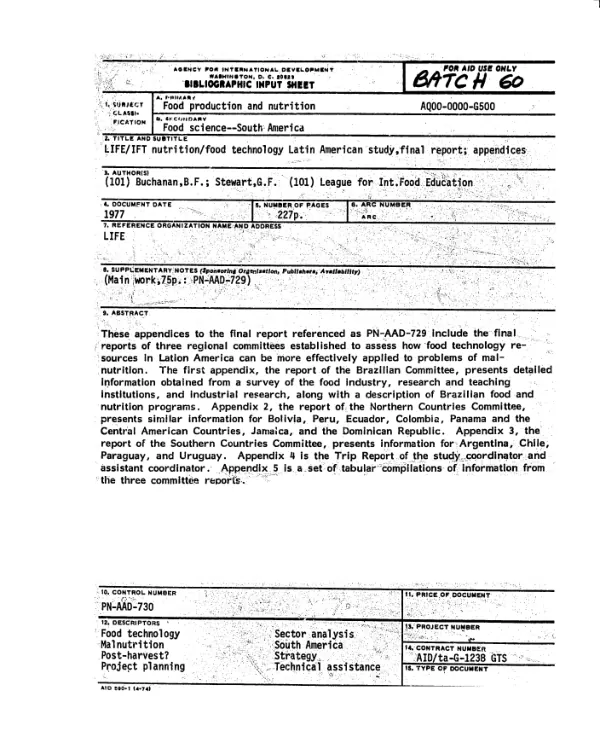
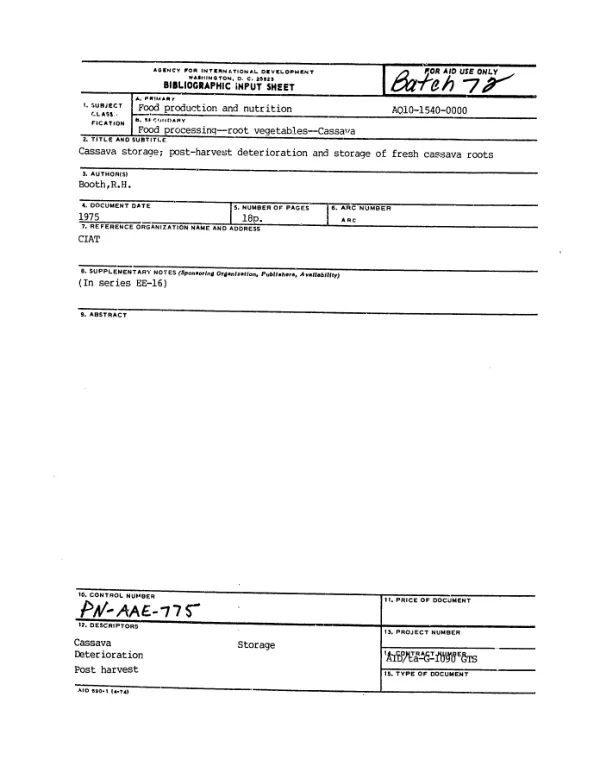
Cassava storage; post-harvest deterioration and storage of fresh cassava roots
Discusses various methods of storing fresh cassava roots to yield maximum returns on the investment made under different circumstances.
Booth, R. H. · 1970
Sign in to readA free account is required to download.
Abstract
Until recently it was generally accepted that cassava roots could not be kept in a fresh state for more than a few days after harvest. This presented serious problems in the marketing and use of the crop and resulted in heavy losses. In order to store these vegetables, it is necessary to understand their postharvest behavior. Two essential requirements of any storage system are: (1) the product should lose as little weight as possible during storage, and (2) it must be of acceptable quality after storage. The rapid postharvest deterioration of cassava roots has been thought to be caused by pathogens or physiological reactions. Two types of deterioration have been identified. Primary deterioration is usually the initial cause of the loss of acceptability by fine blue-black streaks in the vascular tissue which later spread to a more general brown discoloration. Secondary deterioration is due to pathogenic rots, fermentation or softening of the roots, generally after primary deterioration. Cultivars selected for storage should be those that deteriorate less rapidly and that can be harvested with minimum damage. Curing at 80 to 85% relative humidity and 25 to 40 degrees C produces a new cork layer around wounds in three to five days, and suberisation occurs in one to four days. Preliminary trials have indicated that successful curing and storage may be achieved by either placing roots in simple field clamps or by packing them in boxes with a moist material. It is possible that root storage could be further improved by the use of broad-spectrum fungicides.