USAID. MISSION TO INDIA
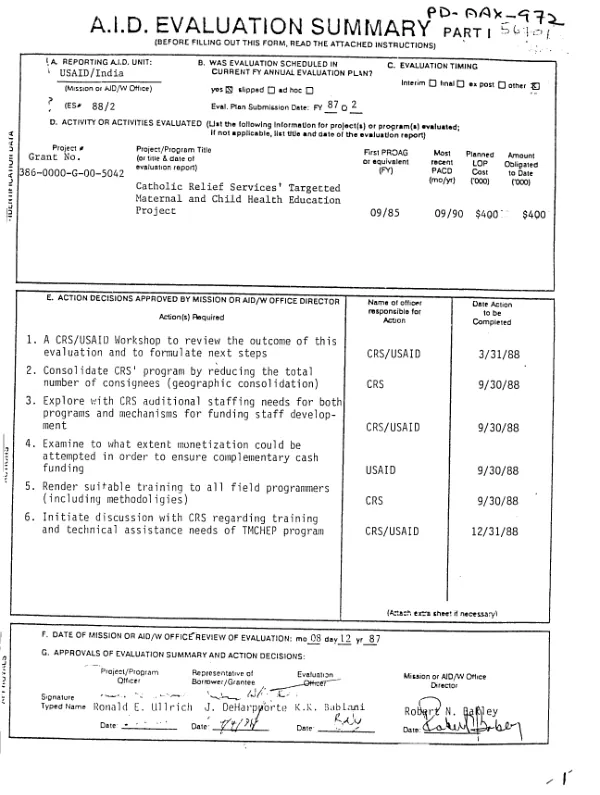
Catholic Relief Services" targeted maternal and child health education project
Summarizes attached evaluation of a grant to Catholic Relief Services (CRS) to provide targeted maternal child health (MCH) services to the poorest of the poor in India.
1988
Sign in to readA free account is required to download.
Abstract
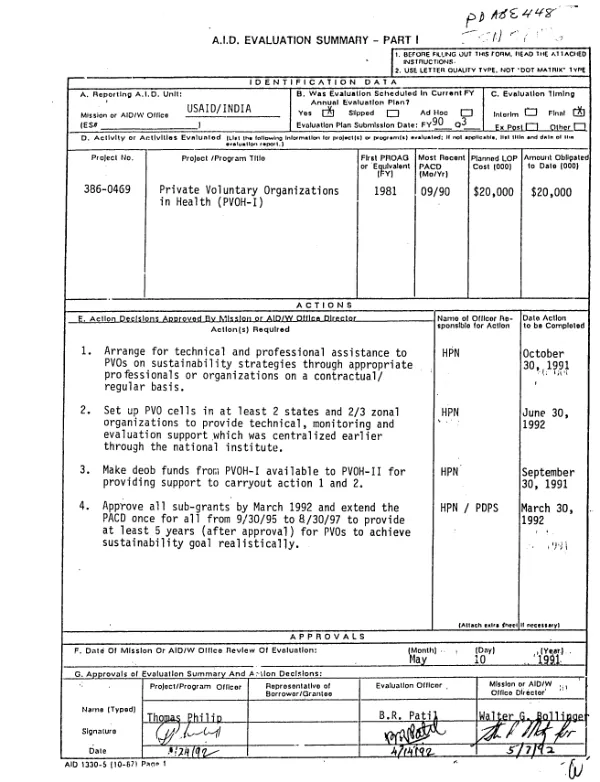
Special evaluation covers the period 1985-6/87 and is based in part on beneficiary interviews. Thirty years of providing on-request MCH services has enabled CRS to build an extensive network of highly committed church counterparts throughout India, but this scattered operational area, coupled with overly general objectives, has now become a major management problem. Even with additional staff, the project would be overextended. In some areas, project activities overlap with the Government of India"s expanding Integrated Child Development Service (ICDS). CRS recognizes that project consolidation is essential, and that greatly expanded staff training and monitoring are needed. Unfortunately, efforts in this direction have been hampered by a lack of technical personnel and training materials and by poor training design (e.g., overconcentration on basic subjects and inadequate hands-on training). At the consignee level, the part-time project coordinators do not have the time or the training to carry out the program adequately, and at the distributor level local aides are not adequately compensated for their work (many receive no compensation at all) or educated (many are illiterates). As a result, growth monitoring is inadequately carried out, immunization coverage is not being verified systematically, and mother education, which stresses general topics such as hygiene, is only partially effective. Although CRS has made considerable progress since 1979 in targeting nutritionally vulnerable under three year olds, it is only recently that specific guidelines have been handed down, and the problems associated with targeting (e.g., eliminating villages from the program, excluding children over three unless severely malnourished) have only begun to be faced. The guidelines are not strictly adhered to, but they have been accepted (reluctantly in some cases). The project has had little influence, however, over how the rations are distributed within the family. Efforts to motivate mothers to reserve foods for themselves and the most vulnerable children must be intensified. Delivery of food rations to beneficiaries has been exceptionally regular. A number of recommendations are made; key ones are to refine project targets to include intermediate goals that can be measured within the exisitng evaluative structure and to develop a consolidation plan. The Mission comments that the project has strong potential, but points up CRS"s need for staff and training support. USAID/I will meet with CRS to discuss strategies for the future and identify possible cash resources.