USAID DEC
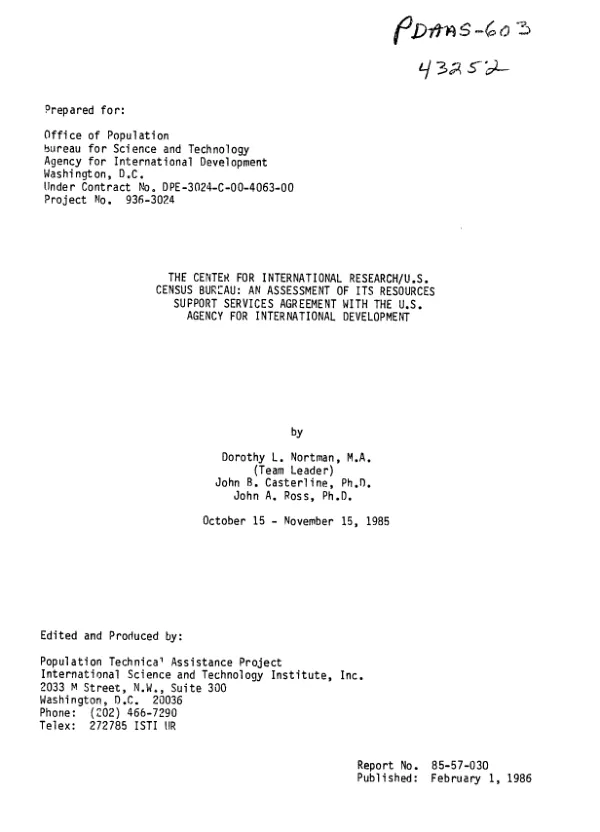
Center for International Research/U.S. Census Bureau : an assessment of its resources support services agreement with the US Agency for International Development
Sign inINTERNATIONAL SCIENCE AND TECHNOLOGY INSTITUTE, INC. (ISTI)
Center for International Research/U.S. Census Bureau : an assessment of its resources support services agreement with the US Agency for International Development
Evaluates the performance of an RSSA team from the U.S.
Nortman, Dorothy L.|Casterline, John B. · 1986
Sign in to readA free account is required to download.
Abstract
Census Bureau's Center for International Research (CIR) in a project to collect and analyze demographic data for A.I.D.'s Population Division (POP). External evaluation, funded under project 9363024, covers the period 1982-1985 and is based on site visits and interviews with organizations working with CIR. The CIR has fulfilled its major obligations under the RSSA, namely, to compile, assess, and disseminate demographic and related socioeconomic data on a world-wide basis. CIR's international data base (IDB) is a reasonably up-to-date, competently evaluated data set which probably provides statistics superior to those produced by the UN Population Division and the World Bank. The CIR staff has strong technical competence and the quality and quantity of work are high. Also, staff members have greatly contributed to demographic literature through independently conducted research. The CIR is weak, however, in certain areas with relevance to AID-supported projects. (1) The IDB has limited information on contraceptive prevalence and detailed fertility rates. (2) The CIR acknowledges that its publications are sporadic, limited, and unattractive and fail to adequately represent the richness of the IDB. (3) There is little communication between POP and CIR. All three problems are remediable. The CIR is very receptive to the suggestion that it pursue and evaluate data on contraceptive prevalence as vigorously as it does traditional demographic variables. To do so, the IDB would have to be upgraded and software provided which could generate a pre-selected listing or grouping of countries and cross-classification of variables. Greater use could also be made of the CIR staff to train LDC nationals in demographic techniques and analysis. Finally, the time is auspicious for improving communication between POP and CIR. A.I.D. could direct to CIR its ad hoc requests for sophisticated demographic expertise, and CIR would be better positioned to do policy-relevant research if it had more direct and frequent communication with AID/W and field staff. It is recommended that A.I.D. fund a follow-on project at the present or higher levels. (Author abstract, modified)