USAID DEC
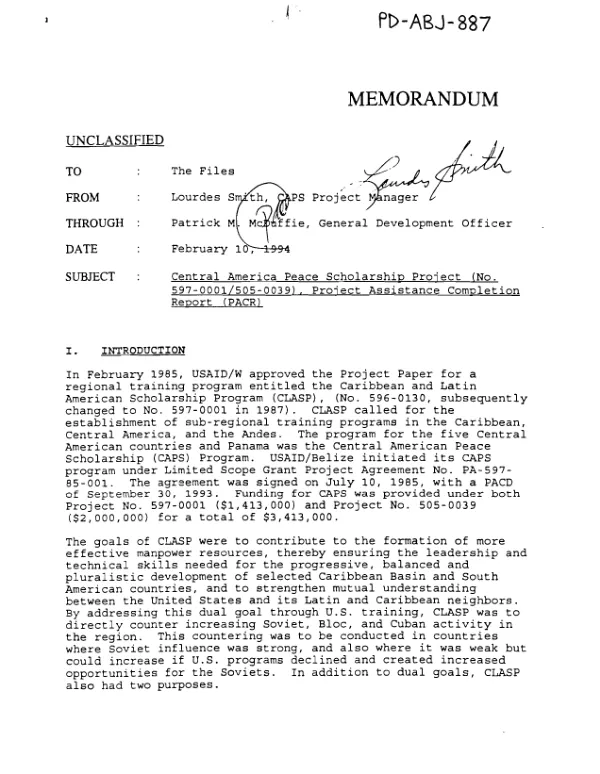
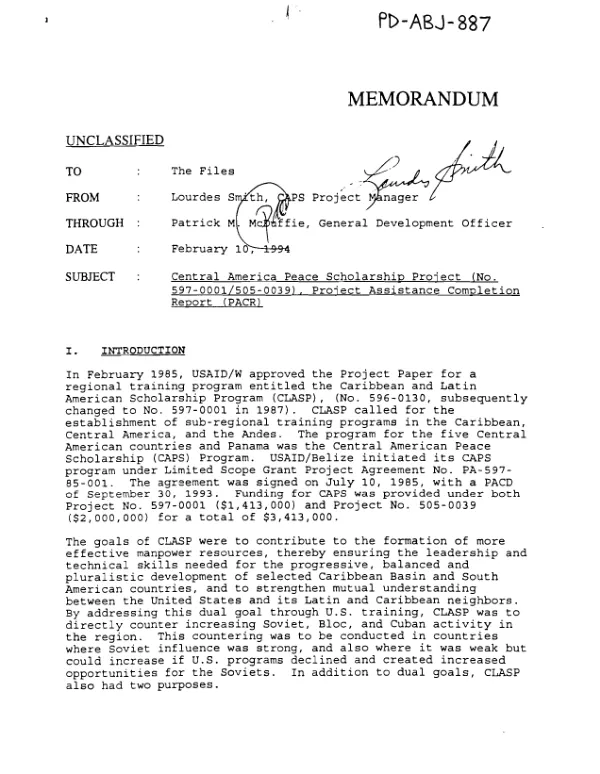
Central America peace scholarship project (no. 597-0001/505-0039) : project assistance completion report (PACR)
Sign inUSAID. BUR. FOR LATIN AMERICA AND THE CARIBBEAN
Central America peace scholarship project (no. 597-0001/505-0039) : project assistance completion report (PACR)
PACR of the Belize component of the Central America Peace Scholarship (CAPS) project (1/85-9/93).
1994
Sign in to readA free account is required to download.
Abstract
The purpose of CAPS was to increase the number of U.S.-trained public and private sector individuals, especially the disadvantaged, at the planning, implementation, technical, and administrative levels. All outputs, as amended, were essentially met, and available data indicate that the training was of overall high quality and responsive to Belize"s development needs. Specifically, the project financed training for a total of 297 participants (63 long-term, 234 short-term), all but two of whom completed their training; 44% of trainees (131) were female. The project was particularly successful in participant selection, and training sites were widely distributed throughout the United States. Returnees were highly satisfied with their training and as a result formed positive images of the United States. In addition, the project promoted socioeconomic ties between Belize and the United States. The project also implemented a Follow-On Program for returnees. However, there were some constraints to implementation. USAID/W, overly anxious to begin the project because of its political significance, did not issue complete instructions for the core Country Training Program (CTP) until the project"s second year. Likewise, the Follow-On Program was added with no clear implementation instructions from the Agency. Simultaneously, cost-containment measures were added while Missions continued to grapple with Experience America, CTPs, and the Follow-On Program. Fortunately, USAID/Belize adapted and there were no delays in training. Additionally, this was a mandated project which USAID had to fund out of its Operating Year Budgets (OYBs), resulting in at least the perception that "regular" USAID projects were suffering budget cuts to fund CAPS. Better planning and guidance, and greater collaboration between the field and USAID/W could have prevented this perception. While the Follow-On Program was innovative and successful under the Belize Chamber of Commerce and Industry for the first five quarters, difficulties arose during the contract"s final months due to staffing changes and lack of commitment. As a result, a hiatus occurred in the Follow-On Program in early 1992 and lasted until 9/92 when Georgetown University signed a contract to implement a joint Follow-On Program. The need for program eligibility requirements is understandable, but the lack of flexibility in training duration prevented the CAPS program from participating in the Entrepreneurs International (EI) program (which established a 28-day minimum) and which would have been an excellent means of establishing lasting links/friendships with U.S. businesses/individuals while promoting trade between the United States and Belize. The following lessons were learned. (1) Participants were more likely to keep in touch with USAID and be active in the Follow-On Program when site visits were made by Mission staff, an easy task given the 2-hour flight between Belize and the United States. (2) Anecdotal evidence suggests that long-term impact may be greater with long-term training. However, there is no empirical evidence to support or contradict this hypothesis. (3) Follow-on programs need to complete the difficult task of providing just the right amount of assistance to their returnees. Too much assistance will make returnees dependent on the program, whereas too little will lead to failure. In addition, a follow-on program has to compete with a returnee"s other responsibilities, including familial and professional obligations, once he/she returns home.