INTERNATIONAL SCIENCE AND TECHNOLOGY INSTITUTE, INC. (ISTI)
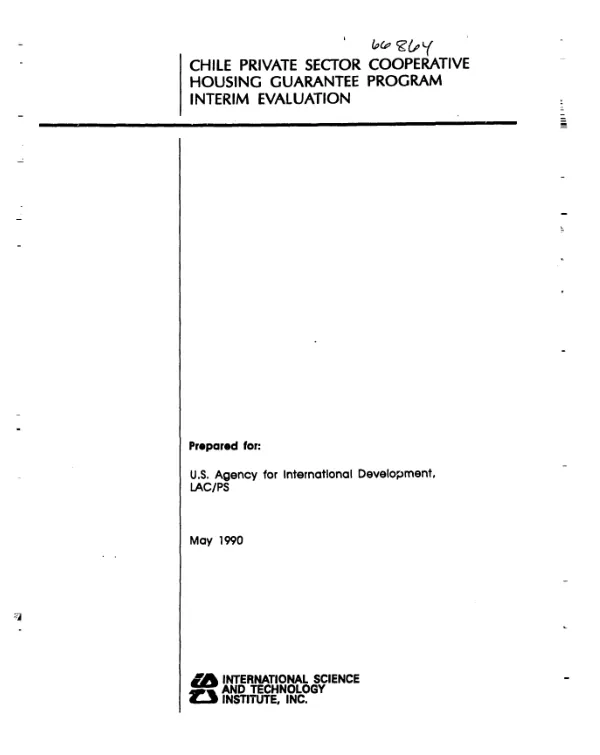
Chile private sector cooperative housing guarantee program : interim evaluation
Evaluates a Housing Guaranty (HG) program in Chile to support private sector cooperatives and serve the needs of low-income families.
Bovet, Claude J. J. · 1990
Sign in to readA free account is required to download.
Abstract
The HG loan was disbursed by Citibank New York in its full amount of US$5 million during July 1988, and Cooperativa Abierta de Vivienda Popular ((COVIP) and its member associations reached full first-round disbursement by September 1989. To date, US$1.2 million have been repaid and re-utilized in second-round disbursements. By the end of 1989, the program had financed 1,120 housing units, of which 822 had been completed for an average price of US$5,904 (UF 328) per unit. The remaining units are in various stages of construction. These prices are affordable to median-income families even without the available Government of Chile (GOC) subsidy. When the subsidy is considered, they are affordable to families earning as little as UF 6 (US$108) per month. These figures indicate that before its half-way mark, the program will produce approximately 67% of the total housing targeted. It can therefore be expected that 3,200 units may be produced by the end of the program's 4-year duration -- 60% over target. Housing units completed by COVIP during 1989 were distributed between the Santiago metropolitan region and the rest of the country at a ratio of 90/10 with HG funds and 66/34 with overall funds. The preponderance of units in Santiago is explained by legal restrictions on cooperatives to operate outside the region where they are established, as well as by high demand for housing in the metropolitan region. COVIP states that use of HG funds has allowed it to increase its housing production by approximately 15% and that, in general, the availability of the funds has permitted housing cooperatives to initiate programs they could not have otherwise funded with commercial banking lines. Bank loans are not available for land purchases and their construction finance lines are extremely expensive. Although responsibility for very low-income groups (families earning below UF 5) normally falls exclusively upon the GOC, it was found that at least one cooperative has managed to service such groups. In each of the last 2 years, PROVICOOP, a COVIP affiliate, has more than doubled the number of "extreme poverty" families which it has serviced out of its total housing solutions: 4% in 1987, 9% in 1988, and 21% in 1989. The administrators of COVIP member associations unanimously pleased with COVIP's effectiveness in providing representation for the program and the GOC. These officials did not believe that COVIP should be transformed into a financial institution itself and, therefore, it has not been capitalized as one. The currency swap arrangements with Chile's Central Bank are fundamental to the continued success of the Program. Use of the available local currency alternative with Citibank Santiago could, depending on market conditions at the time, result in higher interest costs. None of the private sector financial institutions is active, nor has any intentions of becoming active, in originating mortgages for housing units of under UF 400 (US$7,200). In effect, the 2 banks that do originate mortgages only serve markets of UF 700 (US$12,600) and upwards, and the Mutuarias, the market of UF 2,000 (US$36,000) and above. The Banco del Estado, acting as GOC's agent, is the only financial institution currently active in providing mortgages for housing with unit costs of up to UF 400 (US$7,200) and, as such, it is the only channel for financing the mortgages originated by the program and most other programs of the housing cooperative movement. The Chilean solution to its lower-income housing needs relies to a great extent, on a system of direct subsidies which are granted to qualifying families in fixed amounts to cover an important portion (up to 75%) of their home purchase price. Contacts with incoming GOC officials confirmed a firm resolve to maintain the housing subsidy system in its current, basic form, with any eventual changes being oriented towards making it even more accessible to lower-income families and utilizing it to promote innovative shelter solutions reaching out to the "extreme poverty" levels. (Author abstract)