CHEMONICS
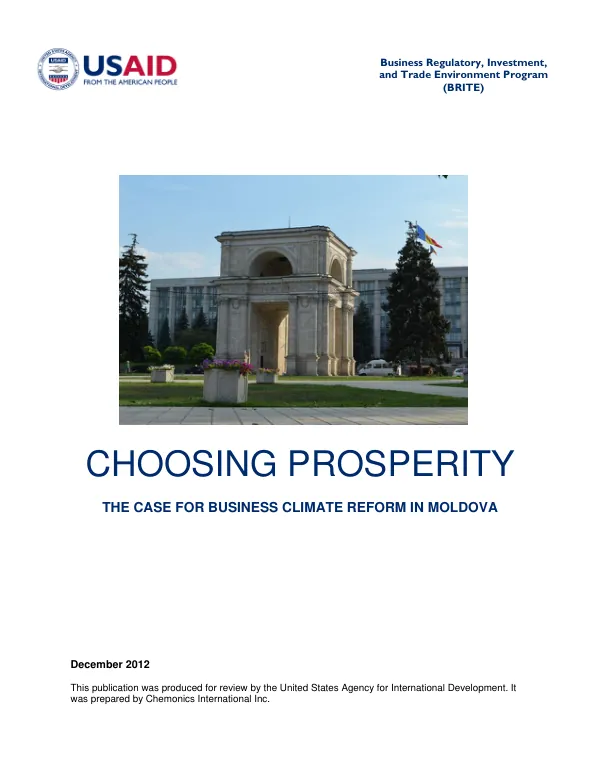
Choosing Prosperity: The Case for Business Climate Reform in Moldova
The Business Regulatory, Investment, and Trade Environment Program (BRITE) in Moldova aims to promote economic growth and job creation through business climate reform.
2012 · 108 pages
Sign in to readA free account is required to download.
Abstract
Moldova, the poorest country in Europe since its independence in 1992, has struggled to develop fair, transparent, and efficient institutions and procedures. A different choice is possible, and with political will, Moldova can choose prosperity for its people. The BRITE project, supported by the U.S. Agency for International Development (USAID), focuses on five key areas for reform: Trading Across Borders, Paying Taxes, Dealing with Construction Permits, Starting a Business, and Protecting Investors. These areas are critical to Moldova's transformation to prosperity and are included in the annual World Bank Doing Business survey. The survey measures the efficiency of national regulatory regimes for ten activities in the life of a business and ranks an economy on each of its 10 indicators in comparison with 185 economies surveyed. The USAID Business Climate Legal & Institutional Reform (BizCLIR) methodology is used to explore in depth the five key regulatory regimes. This methodology provides a systematic framework for identifying the issues that affect a country's performance on the Doing Business survey. The assessment report, prepared for the BRITE project, provides concrete recommendations for reforms in the five key areas. The report identifies several challenges in Moldova's business climate, including a complex and time-consuming process for trading across borders, a high tax burden, and a lack of transparency in dealing with construction permits. The report also highlights the need for improvements in starting a business and protecting investors. To address these challenges, the report recommends reforms in the areas of customs procedures, tax administration, construction permitting, business registration, and investor protection. The BRITE project aims to institutionalize a process of continuous improvement in the business-enabling environment while achieving specific and measurable reforms in the areas of greatest concern to the business community. The project has three components: (1) institutional strengthening, (2) regulatory reform, and (3) business development services. The project will work with Moldovan public and private sector partners to identify technical assistance priorities and implement reforms in the five key areas. The assessment report provides a comprehensive analysis of Moldova's business climate and identifies opportunities for reform. The report's recommendations are intended to assist USAID, BRITE, and their Moldovan public and private sector partners in identifying technical assistance priorities for the new project. By implementing these reforms, Moldova can begin the transformation to prosperity and create a more favorable business climate for investors and entrepreneurs.